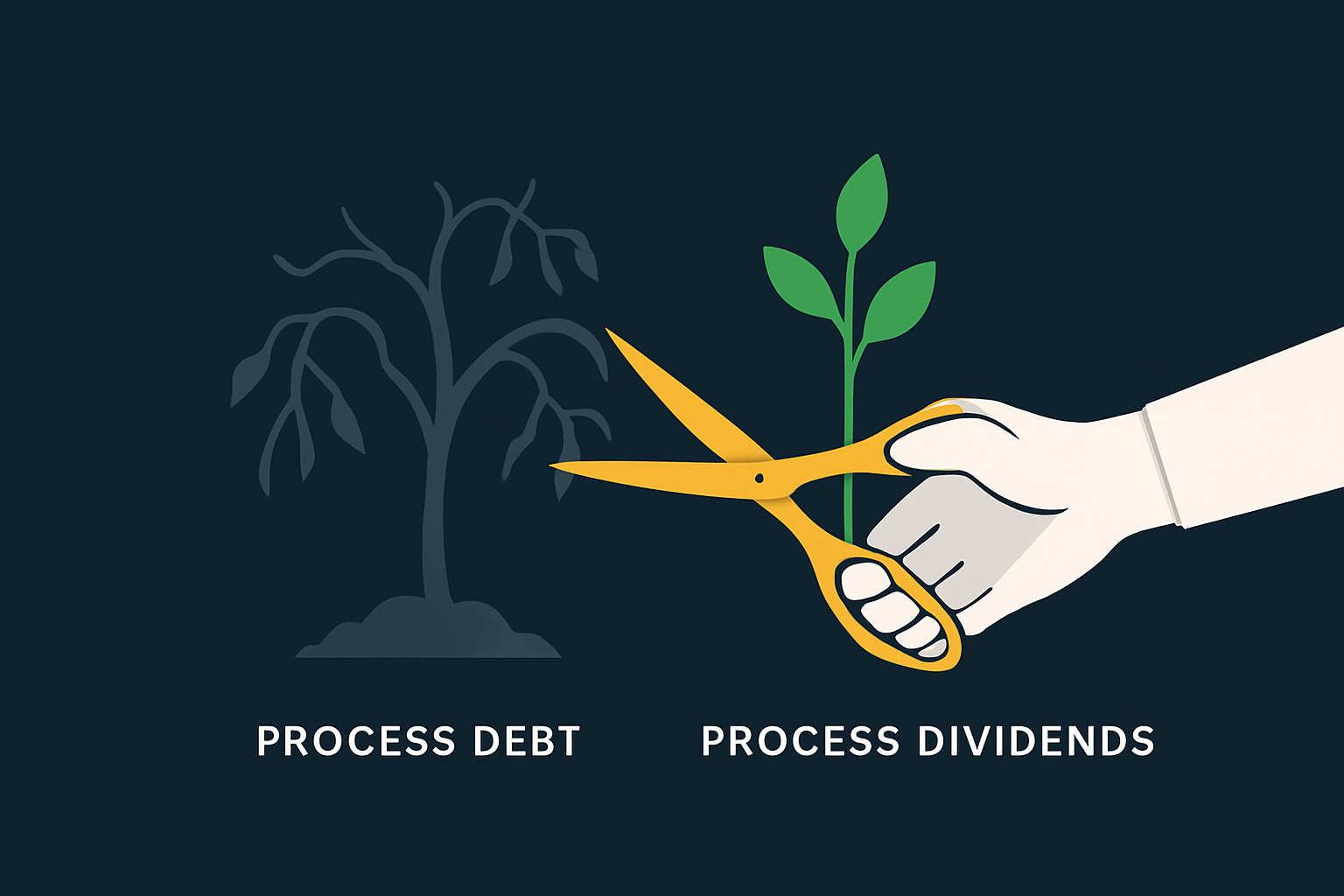
A business running for more than a few years collects systems like a ship collects barnacles. Some are the hull, keeping everything afloat. Others are just remnants of a past voyage—a tool we tried once, a workflow for a dead product line, a manual process we automated years ago but never killed. That accumulation is what I call „process debt.“
It’s a quiet liability. It won’t show up on a balance sheet, but the costs are real. Inefficient, legacy processes can destroy a shocking amount of an organization’s productivity, with some estimates suggesting it could be as high as 20-30%. They create friction, confuse new people, and make the whole business less agile. The question I always hear from other founders is, „We have lots of processes, but half are outdated. How do we clean them up without breaking things?“
The answer isn’t a one-off „spring cleaning.“ It’s a continuous cadence of auditing, pruning, and evolving the systems that run the company. This is the methodology I’ve developed for managing the lifecycle of our core processes, making sure they generate dividends instead of accruing debt.
Our Quarterly ‚Process Debt‘ Review: The Checklist I Use to Identify Outdated Systems
To manage process debt, you have to make it visible. A system rarely fails overnight. It just decays through a thousand small misalignments. A market shift makes its goal irrelevant, new software makes its steps redundant, or team growth turns its manual approvals into a bottleneck.
That’s why we run a formal ‚Process Debt‘ Review every quarter. It’s a non-negotiable meeting where we put our core systems under a microscope. We don’t audit everything, just the processes that are high-volume, cross-functional, or tied directly to revenue and customer experience.
The goal isn’t blame. It’s to find opportunities for improvement, simplification, or retirement. We anchor the discussion around a simple checklist that forces us to be objective.
Here are the core questions we ask:
- Strategic Alignment: Is this process still pointed at our primary goals for this year? A process built to maximize a metric we no longer care about is pure waste.
- Efficiency & Friction: What’s the „work about work“ ratio here? If the coordination effort (chasing approvals, finding information, giving status updates) outweighs the actual value-producing work, the system is broken. Where are the human bottlenecks?
- User Experience (Internal & External): If this process were a product we sell, would our own team give it a good review? Is it intuitive? Fast? Does it create a seamless experience for the actual customer?
- Maintainability & Ownership: Is there a clear owner? Is the documentation current, or does it describe a reality that doesn’t exist anymore? How fragile is it–does it break if a key person is on vacation?
Asking these questions consistently builds a heat map of our operational health. We see which systems are strong, which need refactoring, and which are ready for the scrap heap. This quarterly audit is our single most effective tool for preventing systemic decay.
To make this practical, I’ve formalized our internal checklist into a downloadable worksheet. Use it to run your first Process Debt Review.
The Art of ‚System Sunsetting‘: A Graceful Process for Retiring Old Workflows
Killing off old processes is a blind spot for most companies. We spend endless hours designing and launching new systems, but we rarely apply the same rigor to retiring old ones. The result is the „zombie process“—a workflow no one really uses but that still haunts our documentation, cloud services, and institutional memory. It just creates confusion.
Sunsetting a system should be as thoughtful as creating one. It’s a sign of progress, not failure. It means you’ve evolved. We follow a simple three-step process for this.
Step 1: The Communication Plan
First, announce the retirement date and the reason. Clarity is everything. The team needs to know why the change is happening and what replaces the old workflow. We frame it positively: „We’re retiring the old manual order form on May 31st because the new automated system in the ERP is now fully operational and cuts processing time by 80%.“ This prevents resistance and helps people adapt. (Good thing, too, since in my experience, many digital transformation projects face challenges due to internal resistance.)
Step 2: Data Migration and Archiving
Next, we handle the data. What information in the old system needs to be kept for historical, legal, or operational reasons? We map out a plan to either migrate that data to the new system or archive it somewhere secure and accessible. Just deleting everything is rarely an option.
Step 3: Celebrate the Retirement
Finally, we celebrate. It sounds trivial, I know. But it’s a powerful cultural signal. On the day an old, clunky system is officially turned off, we make a small announcement about the milestone. It reinforces the idea that we’re a company that embraces evolution, that isn’t afraid to let go of the past. It marks the final repayment of a piece of process debt.
Done.
‚The Documentation Is the System‘: Why I Prioritize Updating the SOP Over a ‚Quick Fix‘
There’s always the temptation to make a „quick fix.“ A problem pops up, and an experienced team member finds a clever workaround. They share it verbally, and for now, the issue is solved.
The problem is that the „fix“ only exists in the heads of a few people. The official system – the one a new hire would follow – is now wrong. This creates a two-tiered system: the documented process and the „real“ process. It’s dangerous. It kills trust in our documentation and makes the business dependent on individuals, not systems.
My personal rule is this: the documentation is the system.
Any change to a process, no matter how small, has to be reflected in the Standard Operating Procedure (SOP) before it gets rolled out. If we discover a better way to handle client onboarding, the first step isn’t to tell the team. It’s to open the Client Onboarding playbook, make the edits, and save the new version. The rollout communication is then just, „Please see v2.1 of the Client Onboarding process; changes are highlighted on page 3.“
This approach does a few things for us. It forces clarity, because writing something down makes you think through all the steps. It maintains a single source of truth. And it scales knowledge, so a new team member can be just as effective as a veteran because our best practices are encoded in the system, not in people’s memories.
It takes discipline. It feels slower in the moment than a quick verbal fix, but it’s the only way to build a truly scalable company.
Case Study: Applying Version Control to Our Business Processes at JvG Technology
To make the „documentation is the system“ principle real, we borrowed an idea from software development. Developers use version control to manage complex codebases. We decided to apply the same logic to our operational playbooks at JvG Technology.
Every core process in our company has a version number. Like this:
- Client Onboarding v2.1
- Quarterly Financial Reporting v4.3
- New Supplier Vetting v1.0
The numbering is simple. A major version change (v1.0 to v2.0) means a fundamental overhaul. A minor version change (v2.0 to v2.1) is just a small optimization or clarification.
When we update a process, we don’t just overwrite the old file. We save the new version and update a central changelog. This log is incredibly valuable. It’s a complete historical record of how and why a process has evolved.
With this system, we can suddenly do things that were impossible before. We can audit with precision, looking back to see exactly what the process was at a specific point in time (invaluable for troubleshooting). We can compare versions to understand the impact of an optimization. And if a new process change has unintended negative consequences, we can quickly roll back to the previous stable version.
Treating our processes like software, with clear versions and a history of changes, brought a level of control that was missing when our workflows were just a collection of disconnected documents.
Moving from ‚Process Debt‘ to ‚Process Dividends‘
Managing business systems isn’t a project; it’s a lifecycle. A leader’s job isn’t just to plant new seeds but to prune what’s no longer fruitful and enrich the soil for what’s next.
By establishing a regular cadence for auditing process debt, creating a graceful way to sunset old systems, and maintaining the discipline to treat your documentation as the single source of truth, you shift from accumulating debt to earning dividends. Your processes become assets that create leverage.
The first step is making the commitment to look honestly at your current systems. I encourage you to block off time for your first Quarterly ‚Process Debt‘ Review and just begin the conversation. It’s one of the highest-leverage investments you can make in your company’s future.