Our highest-performing landing page wasn’t a landing page at all. For three straight months, a 2,500-word technical article on the nuances of PERC solar cell technology converted more paid traffic into qualified inquiries than the meticulously designed sales page we’d built for that exact purpose.
It wasn’t supposed to happen this way. The article was written for our organic audience—a deep-dive resource meant to build topical authority. The sales page was for our paid campaigns—optimized for a single click, a single action. Yet the data showed a strange and revealing pattern. Visitors would click our ad, land on the sales page, pause, and then, instead of converting, navigate to the technical article. After spending an average of seven minutes reading, they returned to the contact form to start a conversation.
The article had become an essential, non-optional step in their decision-making process. They refused to convert without it.
The Observation: From Bouncing to Deep Reading
This behavior was a complete inversion of the standard marketing funnel. We expect users to move from broad awareness (an article) to sharp consideration (a sales page). Instead, highly motivated visitors were actively seeking out complexity and depth before they would even consider a simple call to action.
This wasn’t just about engagement. According to research from the Nielsen Norman Group, most users leave a web page in under 20 seconds. Our seven-minute average read time wasn’t just a vanity metric; it was a signal that profound trust was being built in real time. Visitors weren’t just scanning; they were studying. They were validating our expertise before they were willing to engage with our sales process.
The sales page made a promise of performance. The article proved it.
It deconstructed the complex engineering behind that promise, layer by layer. This user flow revealed something fundamental about the psychology of high-stakes B2B decisions: “Before I send this email, I need to be absolutely certain these people understand my world better than I do.”
The sales page made a promise of performance. The article proved it. It deconstructed the complex engineering behind that promise, layer by layer. This user flow revealed something fundamental about the psychology of high-stakes B2B decisions: “Before I send this email, I need to be absolutely certain these people understand my world better than I do.”
The Framework: Engineering a Trust Transfer
This insight forced us to rethink the role of our organic content entirely. It wasn’t just a channel for discovery; it was our primary engine for building trust. While organic search still drives over 53% of all website traffic, its real value lay not just in the volume of visitors but in the quality of the interaction.
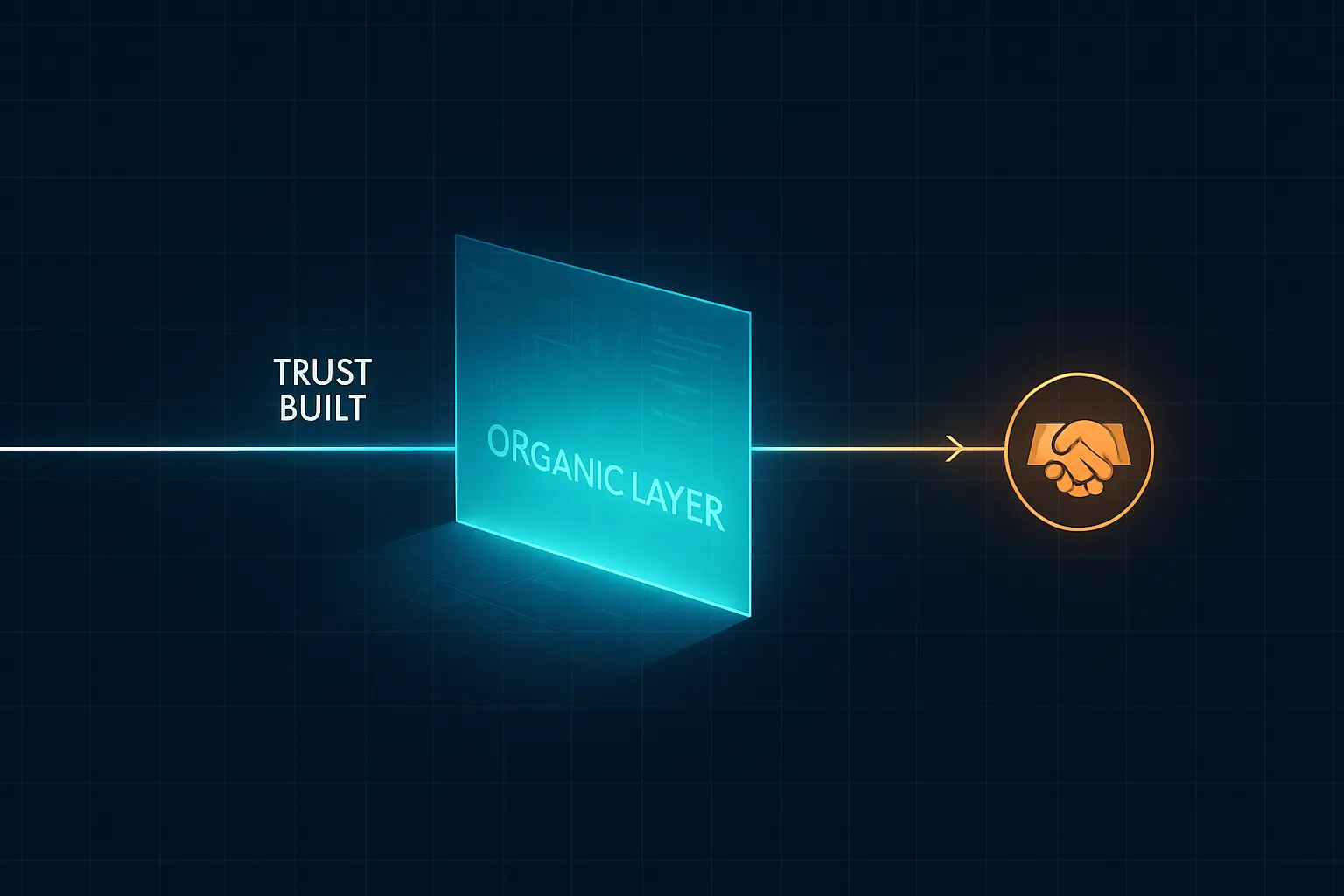
We started viewing our content not as a collection of pages, but as a system designed to facilitate a „trust transfer.“
The system worked like this:
- Acknowledge Complexity: Our sales pages remained clean and focused, but they began to feature prominent links to our deep-dive articles, framed as „Further Reading“ or „Technical Foundations.“ We gave users the off-ramp they were already looking for.
- Demonstrate Expertise: The articles were structured to answer not just the „what,“ but the „why“ and „how.“ They were written from the perspective of an engineer solving a problem, not a marketer selling a solution. This is a core part of an expert-led content approach.
- Create a Return Path: Every technical article ended with a clear, low-friction link back to the relevant consultation or contact page, completing the loop for the newly confident visitor.
This turned our SEO content into a critical mid-funnel asset. It served as a validation layer that satisfied the buyer’s need for due diligence, something a traditional sales page simply can’t accomplish.
The Key Insight: Time-on-Page is a Measure of Trust
The key lesson was that conversion isn’t a singular event. It’s the culmination of a series of trust-building moments. For a complex, high-value purchase, a slick landing page is insufficient. Confidence must be earned through demonstrated expertise.
Our organic layer became the environment where that confidence was built. The time a user spent with our content correlated directly with the trust they were placing in our brand. By designing for this behavior, we stopped treating SEO as a traffic acquisition channel and began architecting it as our most effective conversion system. We weren’t just optimizing for keywords; we were optimizing for cognition and trust.
This shift in thinking has become fundamental to how we approach all of our digital efforts, treating every piece of content as part of the larger project of building systems that scale trust.
Frequently Asked Questions
What is „time-on-page“ and why is it an important metric?
Time-on-page measures the average amount of time visitors spend on a specific page. While not a direct ranking factor for search engines, it’s a powerful indicator of user engagement. A high time-on-page suggests the content is valuable, relevant, and holding the reader’s attention—a strong signal that you are building trust and authority.
Can an informational article really convert better than a dedicated sales page?
Yes, especially for complex or high-cost products and services. A sales page is designed to persuade, while an educational article is designed to inform and empower. In B2B or other considered purchases, buyers prioritize trust and expertise over persuasion. By thoroughly educating a potential customer, you build the confidence they need to make a decision, making the final conversion a more natural next step.
How does this approach change how I should create content?
It encourages you to shift your focus from „selling“ to „serving.“ Instead of asking, „What can we say to convince someone to buy?“ ask, „What does our ideal customer need to understand to make the best possible decision for their business?“ This leads to creating deep, valuable resources that solve real problems and establish your brand as a trusted advisor, not just a vendor.
What is the next step after realizing this behavioral shift?
The next step is to analyze your own data to identify these patterns and then begin treating your content strategy as system design. That means carefully mapping user journeys, strengthening internal linking, and running experiments to see which educational paths lead to the highest-quality conversions.