How Our Marketing System Started Thinking for Itself
There was a distinct moment when I realized our marketing system at Iberosattel was starting to think for itself—not through some dramatic event, but a quiet observation. While reviewing our Google Ads account, I noticed a new ad variant outperforming everything else. Its click-through rate was double our average, and the cost-per-conversion was significantly lower. The copy was simple, direct, and unusually specific. My first thought was to ask which team member wrote it.
The answer was: no one.
The ad copy was lifted, character for character, from a search query a user had typed into Google a few weeks earlier. Our system had identified the query, flagged it as a high-intent search that led to a conversion, and then automatically created an ad test using the customer’s own language. In that moment, the wall between our channels crumbled. Our organic search data was no longer just a report; it had become a teacher for our paid advertising.
The Invisible Walls Between Channels
In most organizations, marketing channels operate in parallel. The SEO team chases rankings, the PPC team optimizes for clicks and conversions, and social media managers focus on engagement. Each is effective in its own silo, but their collective intelligence is often lost. This is a common operational gap; a report from the Digital Marketing Institute highlights that nearly 50% of marketers operate without a truly integrated strategy, leading to disconnected customer experiences and wasted budget.
We were no different initially. Our SEO efforts for Iberosattel were about understanding what terms people used to find high-end dressage saddles, while our paid campaigns were about bidding on those terms to capture immediate demand. The teams shared keyword lists, but the deeper conversation—the why behind a click—wasn’t happening systematically. We treated SEO as an input channel (bringing traffic in) and paid ads as an output channel (pushing messages out). The two rarely spoke to each other in a meaningful way.
Building a Bridge with System Logic
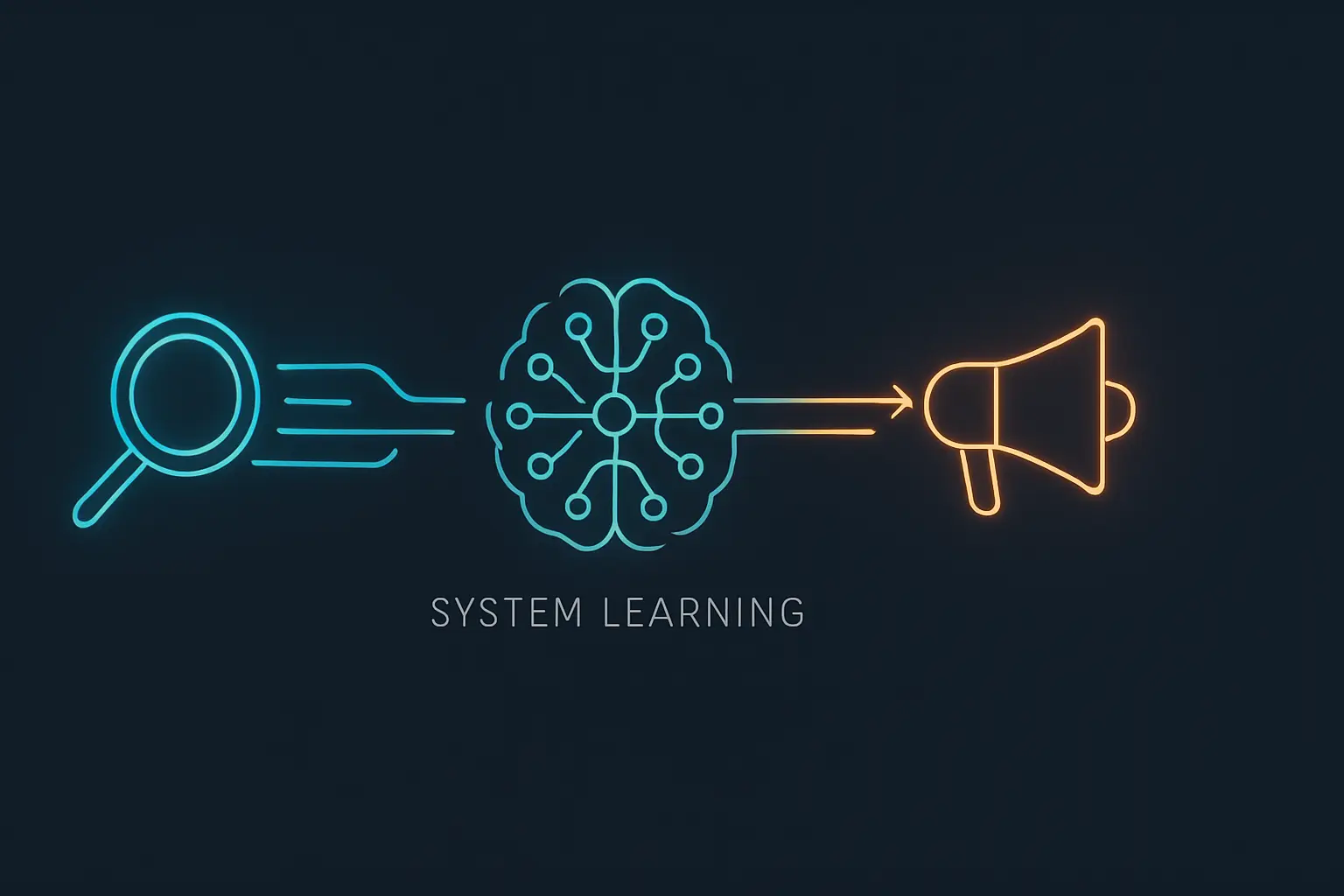
The turning point came when we stopped treating channels as separate functions and started viewing them as a single, interconnected nervous system. We set out to build a simple, automated bridge between our most powerful listening tool (organic search) and our fastest testing tool (paid ads).
We designed the framework for clarity, not complexity.
-
Identify High-Intent Queries: The system connects to Google Search Console and our website analytics, constantly scanning for organic search queries that bring not just traffic, but the right traffic. The logic filters for queries that meet a specific recipe: a high click-through rate, a low bounce rate on the landing page, and a session duration that’s twice the site average. This isn’t about volume; it’s about identifying the precise language of a motivated buyer.
-
Translate Queries into Ad Creative: Once a query is flagged, an automation script takes over. It formats the user’s exact query into a headline for a new ad in a dedicated „Organic Insights“ ad group. The ad description is dynamically populated from the meta description of the high-performing page the user landed on.
-
Deploy and Measure: The new ad is automatically pushed live in a limited-budget test, running against our existing, human-written ads. The system then watches its performance. If it outperforms the control, its budget is increased. If it fails, it’s paused, and the learning is logged.
This entire process is a cornerstone of our approach to building systems that scale. It removes subjective guesswork, replacing it with a direct feedback loop from the market.
When Real Language Outperforms Marketing Copy
The results were immediate and profound. Ads created by the system, using the raw, unedited language of our customers, consistently outperformed our polished marketing copy. We learned that for the highly specialized equestrian audience of Iberosattel, a query like “baroque saddle for short-backed Friesian” was infinitely more powerful as ad copy than a marketer’s attempt at a clever headline.
This reinforces a known truth: authenticity sells. Research by Nielsen has repeatedly shown that consumers trust earned media and peer recommendations above all other forms of advertising. By using a customer’s own search query as ad copy, we were essentially reflecting their intent back at them, creating an ad that felt less like a promotion and more like an answer.
This cross-channel learning became a core part of our strategy. The insights weren’t just for ads. The top-performing „system-generated“ ad headlines inspired blog post titles, email subject lines, and social media posts. The loop was complete.
The Core Insight: Every Channel is a Teacher
We stopped seeing our marketing channels in a linear way. SEO isn’t just for attracting visitors; it’s our most valuable listening post. Paid advertising isn’t just for buying clicks; it’s a real-time laboratory for testing messages.
- Organic Search (The Listener): It tells us what our customers truly want, in their own words, with undeniable clarity.
- Paid Search (The Speaker): It lets us test those exact words to see how the broader market responds, providing instant validation.
This synergy creates a self-perpetuating cycle of improvement. Stronger organic insights lead to more effective ads, and those better-performing ads, in turn, tell us which topics and keywords to invest more in for our organic content strategy. This is the essence of the experimental approach we apply to all our projects. The system learns and refines itself, ensuring growth becomes smarter and more sustainable, not just more expensive.
Frequently Asked Questions
What is a self-learning marketing system?
A self-learning marketing system is an ecosystem where different channels (like SEO, paid ads, and email) are connected so that data and insights from one can automatically inform and improve the others. Instead of manual analysis and cross-departmental meetings, automated rules and data flows create a continuous feedback loop, optimizing performance over time.
Do I need complex AI or a large team for this?
Not at all. The example in this article was built using simple automation tools like Zapier or Make.com, connecting Google Sheets, Google Search Console, and Google Ads APIs. The principle is more important than the technology. You can start by simply having your SEO and PPC teams hold a weekly meeting to share top-performing organic queries and turn them into ad copy tests manually.
How can a small business start applying this principle?
Start small. Once a month, export your top 100 queries from Google Search Console. Look for long-tail keywords (three or more words) with good click-through rates. Pick the top three to five and create a new ad group in your paid search account testing those exact phrases as headlines. You’ll quickly see which customer language resonates most.
Which channels are best for „listening“?
Organic search is arguably the most powerful listening tool because it’s an unfiltered view of customer intent. Other great listening channels include on-site search data (what are people looking for on your website?), customer service chat logs or emails, and social media comments and questions. Any channel where a customer can express themselves in their own words is a goldmine of insight.