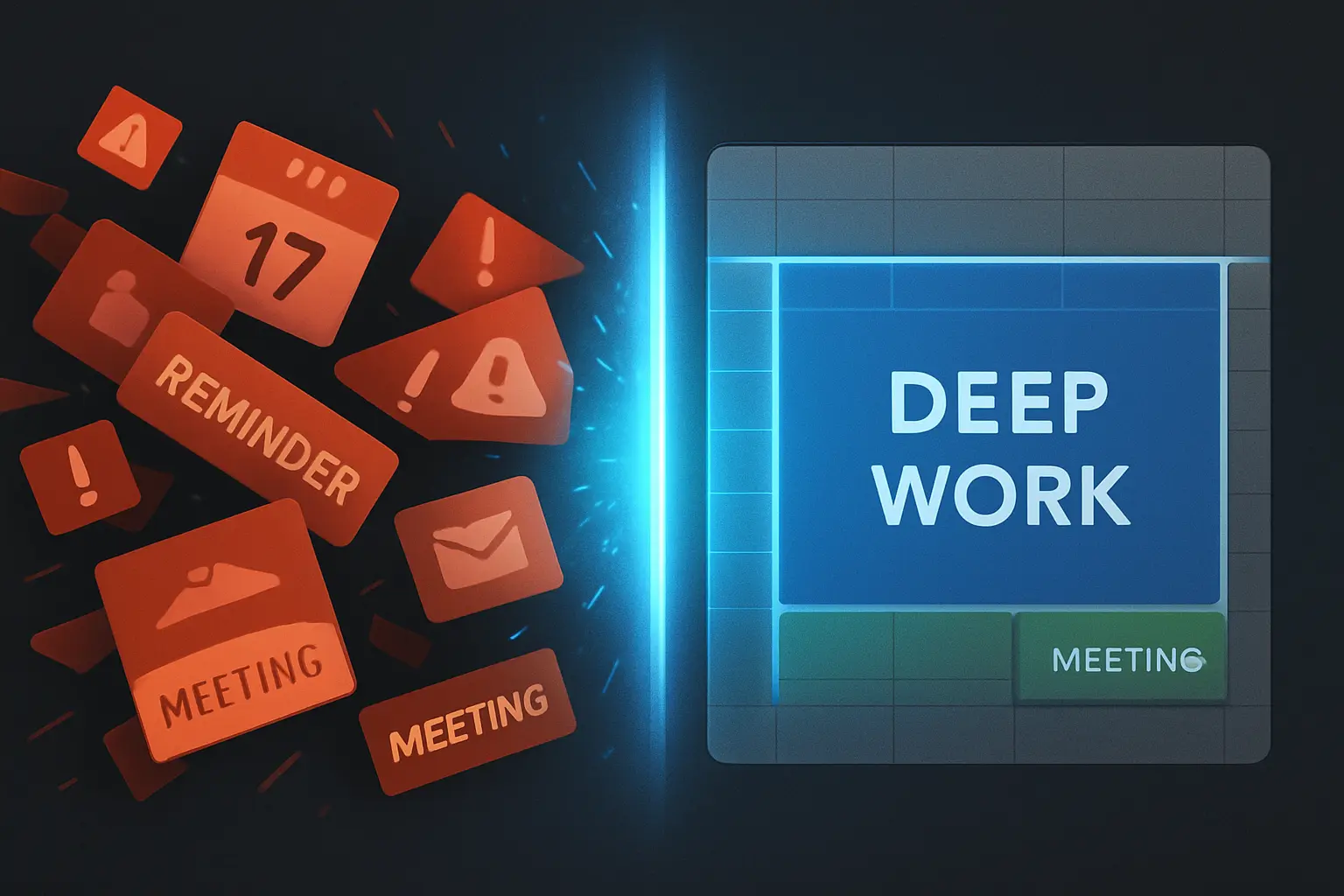
I was looking at my calendar last week and noticed a familiar pattern. It was filled back-to-back with meetings, requests, and tasks that belonged to everyone else’s agenda.
I was busy, but was I moving the needle on the core systems that drive our businesses? The honest answer was no. My calendar had become a public resource, open to the highest bidder of urgency.
This isn’t a failure of time management; it’s a failure of system design. An open, unprotected calendar is the default for most founders and operators, but it’s a system built for reactivity, not strategic progress.
The Default Calendar Is a Broken System
An unprotected calendar is an open invitation for interruption. Each meeting request, each ‚quick question‘ on Slack, and each email alert is a small cut to your focus. Individually, they seem harmless, but collectively they destroy the long, uninterrupted stretches required for strategic thinking and system building.
The data backs this up. A 2021 study by Asana’s Anatomy of Work Index found that the average knowledge worker spends a staggering 60% of their time on ‚work about work’—things like communicating about tasks, searching for information, and managing shifting priorities. That leaves just 40% for the skilled, strategic work they were hired for.
Worse still is the cost of context switching. Research from the University of California, Irvine, revealed it takes an average of 23 minutes and 15 seconds to get back on track after a single interruption. Two ‚quick‘ interruptions can cost you an hour of productive focus. In effect, my calendar was a system designed to maximize these interruptions. I decided to run an experiment to design a new one.
Designing the Time-Gating Protocol
My goal wasn’t just to block out time; it was to build a defensive system around it. I call this system ‚Time-Gating.‘ It’s a set of rules and automations that treats my focus as the most valuable asset and protects it accordingly.
The core idea is simple: My week is divided into distinct zones, each with its own rules of engagement. Instead of a free-for-all, there are specific ‚gates‘ through which different types of work and communication are allowed to pass.
Here’s how the zones are structured in my current iteration:
-
Deep Work Blocks (Non-Negotiable): These are 3-4 hour blocks, typically in the morning, reserved for one thing: building and designing systems. This is when I work on JvG Technology’s production line logic, map out automation for Mehrklicks, or develop new frameworks. During these blocks, my phone is off, notifications are disabled, and my team knows not to interrupt unless it’s a genuine emergency. This is the very work Cal Newport described as the key to producing at an elite level, requiring total immersion. It’s my defense against the McKinsey finding that high-skill workers spend 28% of their day just on email.
-
Shallow Work / Comms Batches: This is for the ‚work about work.‘ I have two 60-minute blocks per day to process emails, answer Slack messages, and handle administrative tasks. By batching these tasks, I prevent them from fragmenting my entire day. This is also where I test things like our experiments with AI-driven communication filters, which help process the noise even faster.
-
Meeting Windows (The ‚Gates‘): This is the most critical part of the system. I only allow external meetings to be booked on Tuesday and Thursday afternoons. These are the gates. Anyone who wants to schedule time with me is automatically routed to these windows via my scheduling link. This single rule has had the most profound impact, transforming my calendar from reactive to proactive.
The Automation Layer: Building the Gates
A system is only as good as its enforcement. Discipline is finite, so I use technology to make the protocol the path of least resistance.
My scheduling tool (I use Calendly, but others work too) is configured with strict rules. It only shows availability within my designated ‚Meeting Windows.‘ It simply cannot offer a slot during a Monday morning Deep Work block. This removes me as the bottleneck and decision-maker. The system handles the defense automatically.
This isn’t about being rigid; it’s about creating a structure that enables flexibility. By protecting the core, I have more mental and emotional energy for the times when I’m available. It’s a core principle I apply when designing scalable business models—protect the engine, and the vehicle can go anywhere.
The Unexpected Outcome: More Clarity, Less Friction
After running this system for several months, the biggest benefit isn’t just increased output. It’s a profound sense of calm and control.
I no longer suffer from the low-grade anxiety of a pending interruption. A fascinating study in the Journal of Experimental Psychology found that the mere anticipation of an interruption can be as detrimental to performance as the interruption itself. Time-Gating removes that anticipation. When I’m in a Deep Work block, I know I won’t be interrupted, allowing for full cognitive immersion.
It has also reduced decision fatigue. I no longer spend mental energy negotiating meeting times. The system presents the available options, and people choose one. The process is clear, respectful, and incredibly efficient.
Frequently Asked Questions about Time-Gating
When I’ve discussed this with other founders, a few questions always come up. Here are my thoughts.
What if there’s an emergency?
The system is designed to filter out non-urgent requests that are often framed as urgent. A true emergency—a server is down, a critical production line is stopped—has a direct, immediate channel, like a phone call. The Time-Gating system is for everything else, which covers 99% of daily communication.
Doesn’t this make you seem unavailable or inflexible?
Initially, I worried about this, but I’ve found the opposite to be true. It signals that your time is structured and valuable, which paradoxically increases others‘ respect for it. People appreciate the clarity. Instead of a drawn-out email chain trying to find a time, they get a link with clear options. It’s a faster, more respectful process for everyone.
How do you start implementing this without disrupting your team?
You don’t have to boil the ocean. Start with one protected block. Block out every Wednesday morning for ‚Deep Work‘ and communicate to your team why you’re doing it: ‚I’m protecting this time to focus on solving our biggest challenges, which will help all of us.‘ This approach is part of how I approach team productivity systems—introduce change as a collaborative experiment focused on a shared goal.
What tools are essential?
You can start with just your calendar and the discipline to decline requests that fall outside your rules. But an automated scheduling tool like Calendly, Cron, or SavvyCal is the key to making the system robust and effortless to maintain. The tool enforces the gates so you don’t have to.
Next Steps: From Blocking Time to Building Systems
Your calendar isn’t a to-do list; it’s one of the most powerful strategic assets you control. Treating it as such requires moving from passive time management to active time design.
Time-Gating is the system I’ve built to do that. It’s an ongoing experiment, but it has fundamentally shifted my work from reactive fire-fighting to proactive system-building.
I’ll leave you with a question I now ask myself at the start of each week: What is the one system, project, or idea that, if I had four hours of protected, uninterrupted time to work on it, would fundamentally change the trajectory of my business?
Then, I make sure there’s a gate protecting that time.