The Social Signal Layer: Why Visionary B2B Marketing Outperforms Technical Specs
Last quarter, we ran what I thought was a straightforward messaging test on Meta. Our goal was simple: find the best way to talk about the complex solar module production lines we build at JvG Technology. We designed two ad variants targeting the same audience of engineers, project developers, and renewable energy executives.
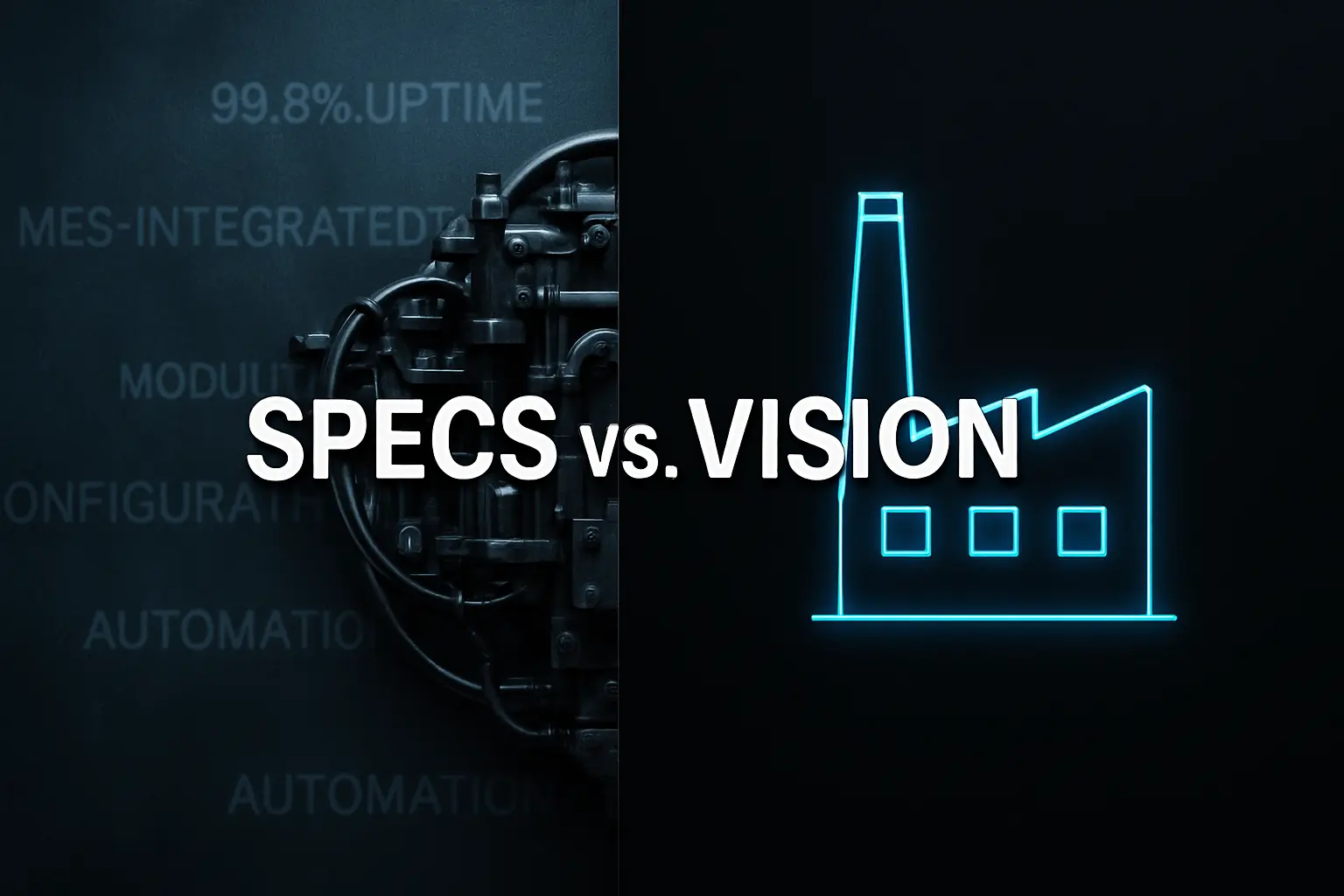
Ad A was the logical choice: precise, data-driven, and technical. The headline read, „99.8% Uptime & 24/7 MES-Integrated Production.“ It listed key specifications, efficiency metrics, and the components that make our systems robust. It was the ad I, as an engineer, would want to see.
Ad B felt almost too simple, too broad. Its headline was just five words: „Build Your Own Solar Factory.“ The image wasn’t a machine but a blueprint schematic overlaid on a photo of an empty warehouse. It spoke not to the how, but to the what if.
The results weren’t just different; they were revelatory. Ad A, the technical one, earned a few clicks, mostly from people already deep in the procurement process. It preached to the choir. Ad B, the aspirational one, behaved entirely differently. It triggered comments, shares, and a stream of inquiries from a much wider audience—entrepreneurs, regional investors, and even government officials. It wasn’t just an ad; it became a conversation starter.
Observation 1: Selling a Component vs. Selling a Capability
The data revealed a clean split. The technical ad landed as a component—a piece of a larger, pre-existing plan. It attracted people searching for a specific machine to fill a slot in a project they had already designed. Its language was exclusive, resonating only with those who understood the jargon.
The „Build Your Own Solar Factory“ ad, however, wasn’t selling a component. It was selling a new capability.
It gave the audience a powerful mental model. Suddenly, they weren’t just buying machinery; they were acquiring industrial sovereignty. They were building an asset, creating jobs, and establishing energy independence for their region. The ad spoke not only to the engineer responsible for uptime but also to the founder responsible for the vision and the investor responsible for the return.
Framework 1: The Outcome Layer
This experiment highlighted a critical blind spot. We were busy explaining the intricate details of our tools, while the market was looking for someone to hand them a key and a map. This led me to see our communication not as a single message but as a system with distinct layers. At the core is the Technical Layer (the specs, the data, the “how”). This is essential for building credibility with experts and closing deals. But before anyone cares about the how, you need to establish the Outcome Layer (the “what for,” the new capability, the reason to change).
The Outcome Layer is the human-readable mission statement for your technology, translating complex features into a simple, powerful promise.
-
Technical Layer: “MES-integrated automation for module transport.”
-
Outcome Layer: “A factory that runs itself, reliably.”
-
Technical Layer: “High-precision stringer with infrared soldering.”
-
Outcome Layer: “Solar panels that last for decades.”
On a social feed, you have less than three seconds to earn attention. Technical specifications don’t create an emotional hook; a vision does. The primary job of top-of-funnel communication is not to educate on features but to establish a compelling outcome.
The Blueprint Effect: Why an Unfinished Drawing Outperformed Our Finished Product
As we searched for the right language, we naturally turned to visuals. Conventional wisdom says to show the final product: clean, polished, powerful, and complete. Following that logic, we produced a series of high-resolution photographs and videos of our fully operational solar module production lines.
Alongside these polished assets, we tested something raw and conceptual: a simple 2D CAD blueprint of a factory layout. We ran it as an ad on Meta, targeting the same audience.
The polished photos performed as expected. The blueprint, however, drove a significantly higher, and more specific, kind of engagement: more clicks, more saves, and comments that focused on inquiry rather than praise. People asked, „Can this be configured for a smaller space?“ or „What’s the integration potential with X system?“
Observation 2: The Psychology of the Unfinished
The polished photo was a statement: “Here is the finished, perfect solution.” It was impressive but also a closed loop. It presented an answer, leaving little room for the viewer’s imagination.
The blueprint, by contrast, was an invitation. It implicitly communicated, „Here is a plan. Let’s build it together.“ By showing an unfinished design, we created a psychological space where the viewer can mentally step in and project their own needs onto the design. It tapped into the „IKEA effect,“ where people place higher value on products they partially created. It transformed passive viewers into active participants.
Framework 2: Invitation vs. Demonstration
This experiment forced us to re-evaluate the role of visuals in a complex B2B sales cycle. We had been operating under a „demonstration“ model. The blueprint’s success suggested an alternative: an „invitation“ model.
- Demonstration Model: Aims to impress with a finished result. The messaging is, “Look at what we built.”
- Invitation Model: Aims to engage the viewer in a process. The messaging is, “Look at what we can build together.”
For a systemic product like a factory line, the invitation model proved far more effective at the top of the funnel.
Insight: Frame the Capability First, Then Explain the Technology
The core insight from both experiments was this: The first bridge you build to a new market isn’t technical, but conceptual. Before you can explain why your solution is better, you have to frame the new potential it unlocks.
In high-value B2B, you are selling a collaborative, long-term relationship. The most effective early-stage content may not be the one showing the final result but the one that best illustrates the potential for partnership. The lesson was clear: lead with the capability, and you earn the right to explain the technology. Don’t just show the destination; give them a map and invite them on the journey.
Frequently Asked Questions
-
Does this mean technical details aren’t important in marketing?
Not at all. Technical details are crucial for building trust, but they are most effective further down the funnel for an audience that has already bought into the „why“ and is now evaluating the „how.“ -
How do you find the right „outcome“ language?
Listen to your customers. The language they use to articulate their goals—“control over our supply chain,” “a tangible asset for our community”—provides the raw material for your outcome-based messaging. -
Is this approach only for social media?
While social media is an excellent testing ground, the principle applies everywhere. Your website homepage, sales decks, and introductory emails should all lead with the new capability you offer. -
Does this mean professional photography is a waste of money?
Absolutely not. High-quality photos of finished projects are essential for case studies and final proposals. They serve as proof. For initial engagement, however, conceptual or process-oriented visuals can be more effective. -
How can a non-manufacturing business apply the „blueprint effect“?
The principle is universal. A software company could show a wireframe. A consulting firm could show a whiteboard sketch of their strategic framework. The key is to visualize your process, not just the polished end result. -
Did the conceptual ads generate qualified leads?
Yes, but they came at an earlier stage, driven more by „I have an idea, can you help me explore it?“ This is incredibly valuable because it allows you to enter the conversation as a strategic partner before requirements are set in stone.