When we reactivated Photovoltaik.info, the domain had been dormant for over five years. On the surface, it was a ghost town. Digging deeper, it was a ruin—thousands of outdated pages, broken links, and a structure so decayed it was almost entirely invisible to search engines, yet stubbornly indexed.
Most would see this as a liability. I saw it as the perfect laboratory.
The German residential solar market is growing at an incredible pace, expected to add 22GW of capacity annually from 2026. Yet, the online space is dominated by e-commerce sites focused on transactions, not education. They sell products but fail to answer the critical questions homeowners have about financial feasibility, long-term efficiency, and the complex reality of self-consumption.
This project chronicles the rebuilding of Photovoltaik.info not with aggressive marketing, but with clean architecture and system integrity. It’s an experiment to prove a core belief: a well-designed system can grow entirely on its own, earning trust and visibility without a single backlink.
Phase 1: Diagnostic & Reconstruction (Feb – May 2025)
The first ninety days weren’t about growth; they were about control. Before we could build anything new, we had to map the decay, clear the rubble, and lay a foundation that could support future automation.
Auditing Five Years of Digital Silence
Observation: Our first crawl returned over 4,000 URLs. Most were thin, duplicated, or pointed to content that was technically and legally obsolete. The site was a perfect example of digital entropy—a collection of assets that had lost all coherence. A simple cleanup wouldn’t work. We needed a full demolition and a new blueprint.
Framework: The process was methodical. We exported every indexed URL and manually triaged them into three buckets:
-
Delete: Content that was irrelevant, thin, or harmful (over 80% of the site). We systematically de-indexed and removed them.
-
Redirect: Pages with residual authority or backlinks that mapped to a future topic. These were rare but important to preserve.
-
Rebuild: Core concepts (e.g., „self-consumption,“ „solar financing“) that were still relevant but required a complete rewrite from the ground up.
Insight: Reviving an old domain isn’t about saving old content. It’s about salvaging old meaning. The value wasn’t in the text but in the history of the URLs. By understanding what the domain once tried to be, we could design a more intelligent version of its future.
Designing a Scalable Knowledge Architecture
Observation: The primary weakness of most informational sites is a flat, blog-style structure where topics are disconnected and the user’s journey is chaotic. To avoid this, we designed a rigid pillar–silo–sub-silo architecture before writing a single word. Our goal was to create a logical map of the entire residential solar landscape.
Framework: The structure is based on user intent. The top-level pillar, „Photovoltaik for Private Homes,“ addresses the broadest questions. Beneath it are major silos like „Planning & Costs,“ „Components,“ and „Operation & Optimization.“ Each silo is then broken down into sub-silos that answer highly specific questions. This hierarchy does more than organize content; it signals to search engines that we have deep, structured expertise on the entire topic cluster.
Insight: A scalable system requires a logical skeleton. By defining the entire information architecture in advance, we ensure that every new piece of content has a designated place, strengthens the surrounding topics, and contributes to the site’s overall authority.
Phase 2: Content Relaunch (May – Jul 2025)
With a clean foundation and a clear blueprint, we began publishing. This phase wasn’t about volume but precision: surgically placing the right content into the new structure to re-establish topical authority and invite search engines to re-evaluate the domain.
Rewriting for Intent: The Self-Consumption Example
Observation: Our research showed a massive content gap. Competitors talk about self-consumption, but their calculators are simplistic sales tools. They rarely mention that a typical solar setup without a battery only achieves a 25-40% self-consumption rate. They don’t discuss critical variables like household load profiles or seasonal variance. This is where we decided to plant our flag.
Framework: Our first major piece was a definitive guide to calculating self-consumption accurately. We didn’t just provide a formula; we provided a framework for thinking. We explained how to analyze energy usage patterns, model the difference between summer sun and winter gloom, and account for the real-world efficiency of battery storage. We addressed the user’s true goal: avoiding a costly mistake.
Insight: True authority comes from answering the questions competitors won’t. By tackling the most complex, nuanced topics with radical transparency, you become the trusted resource for serious decision-makers.
Launching the First Content Pillars
Observation: The first new pages went live in May. We published the primary pillar page and the first five supporting articles in the „Planning & Costs“ silo. Then we stopped and waited. The goal wasn’t to flood the index but to provide a clean, coherent cluster of high-value content for re-evaluation.
Framework: Our launch strategy was patient and deliberate. Each new article was meticulously optimized: clean metadata, structured data, and, most importantly, logical internal links to its parent silo and the main pillar. This sent a clear signal that our content wasn’t just new—it was part of a highly organized, interconnected system.
Insight: A relaunch is a conversation with search algorithms. Shouting with hundreds of new pages creates noise. Speaking clearly with a small, perfectly structured set of pages invites a proper assessment and builds foundational trust.
Phase 3: Organic Growth (Aug – Oct 2025)
For the first six weeks, nothing happened. Clicks and impressions flatlined near zero. This is the phase where most strategies fail due to impatience. But we weren’t waiting for a magic bullet; we were waiting for the system to take root.
The 8-Week Wait: When Structure Triggers Visibility
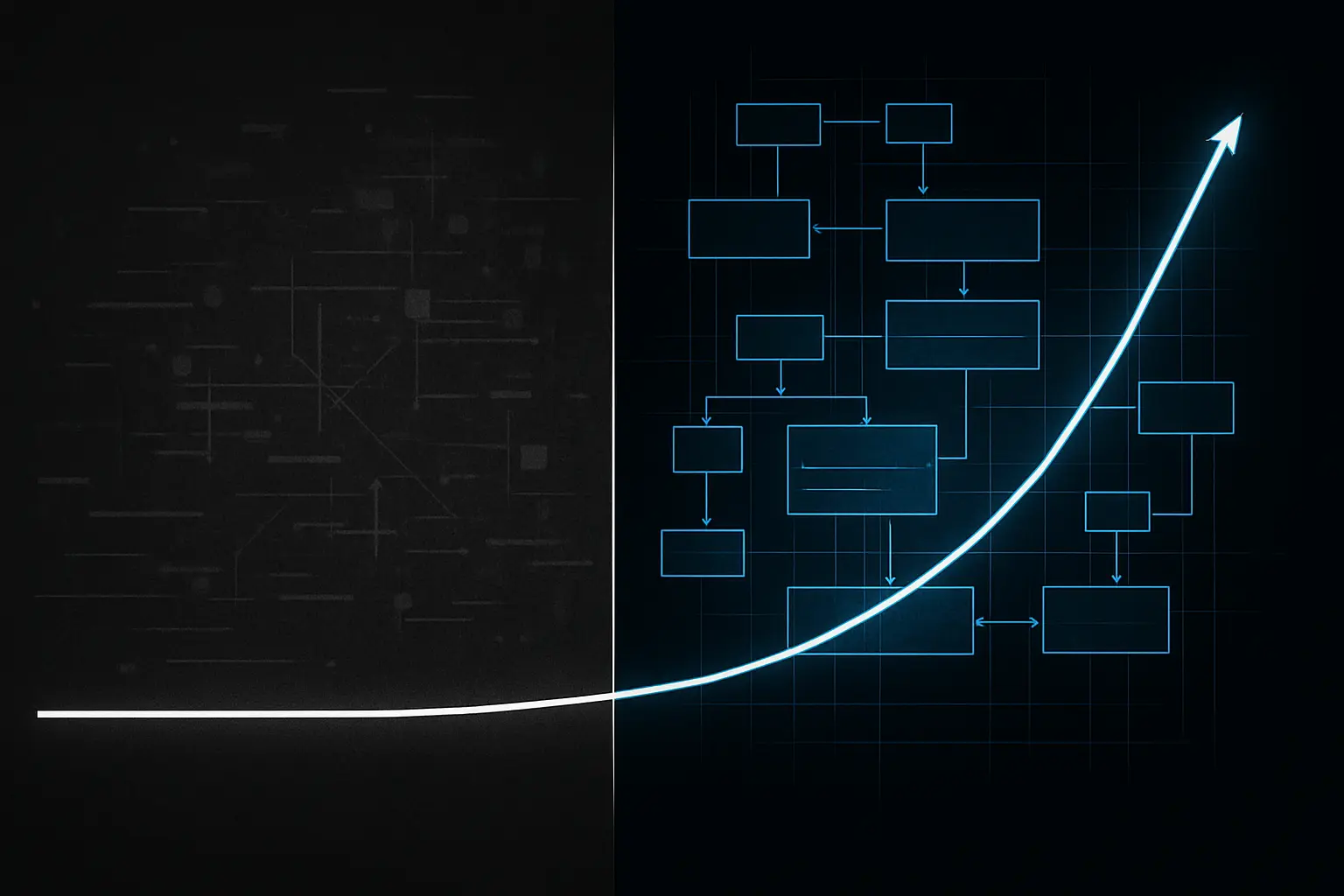
Observation: Around week eight, the metrics began to shift. First, impressions started climbing steadily. A week later, clicks followed. By October, the growth was exponential. We saw a dramatic increase in visibility not for random keywords, but for the exact core topics we had targeted in our new architecture.
Framework: This growth wasn’t an accident; it was a validation of our hypothesis. By creating a clean, hierarchical structure and satisfying user intent on difficult topics, we demonstrated a level of authority that algorithms are designed to recognize and reward. We didn’t need external signals like backlinks because the internal signals—clarity, depth, and organization—were overwhelmingly strong.
Insight: Organic growth driven by structure is healthier and more defensible than growth driven by links. The system itself becomes your moat. It’s a slower start, but the momentum, once established, is powerful and compounds over time.
Analyzing the Curve: Clicks Without Links
Observation: A deep dive into Search Console data confirmed our approach. The pages ranking highest were those that sat at the logical center of our content silos—the ones that answered the most complex questions and were most densely interlinked. The traffic wasn’t coming from a viral post; it was distributed across the entire system, indicating that Google understood and trusted the whole architecture.
Framework: We monitor the ratio of internal links to impressions for key pages. A well-structured silo should show its primary pages accumulating impressions for a wide range of related long-tail keywords. This proves that topical authority is being consolidated correctly. We weren’t just ranking for „photovoltaik eigenverbrauch“; we were starting to appear for dozens of variations because our structure proved we owned the topic.
Insight: You don’t need to build a single backlink when your website’s internal logic is stronger than your competitors‘. A clean architecture acts as its own endorsement.
Phase 4: Automation & Optimization (Ongoing)
With organic trust established, the final phase focuses on turning the site into a semi-autonomous system. The goal is to use data to refine and expand the knowledge base with minimal manual intervention, enabling it to adapt and grow intelligently.
Automating Internal Logic: Teaching the System to Link
Observation: As a site grows to hundreds of pages, manually maintaining a perfect internal linking structure becomes impossible. Human error and neglect lead to isolated pages and diluted authority—a system problem that demanded a system solution.
Framework: We integrated an in-house tool that uses AI to manage the site’s linking logic. The system analyzes search intent data from Search Console and automatically suggests or places contextual internal links between related articles. If a new article on „battery efficiency“ is published, the system identifies every existing page that mentions battery storage and links them together. It ensures every page is woven into the larger fabric of the site’s knowledge.
Insight: Automation isn’t about replacing human strategy; it’s about executing it perfectly at scale. By teaching our system the rules of good architecture, we ensure the site maintains its structural integrity and authority as it grows.
From Static Content to a Dynamic Knowledge Base
Observation: Search intent is not static. The questions users ask about solar energy will change as technology evolves and regulations shift. A website that isn’t updated becomes obsolete.
Framework: Our system now includes SEO monitoring that flags „content decay“—pages that begin to lose visibility for their target keywords. It also identifies new „striking distance“ keywords where we could rank with a simple content update. This shifts our editorial process from reactive to proactive. We don’t guess what needs updating; the data tells us exactly where to focus our efforts.
Insight: A truly scalable system is not just built; it learns and adapts. By closing the loop between real-time search data and our content strategy, Photovoltaik.info is no longer just a website. It is a responsive system designed for continuous growth.
Frequently Asked Questions
Why not just build backlinks to speed up the process?
Backlinks are a vote of confidence from an external site. A clean internal architecture is a statement of confidence in your own content. We chose to prove the value of our system on its own merits first. This creates a foundation that is immune to algorithm shifts targeting manipulative link schemes. Authority earned through structure is authority you truly own.
How much of the old content was kept?
Less than 1%. It was more efficient to perform a strategic demolition than to attempt to renovate a broken structure. We rebuilt core topic pages from scratch using modern data and a deep understanding of current user intent.
Is this approach suitable for a brand new domain?
Absolutely. The principles of designing a clear architecture and focusing on user intent before anything else are even more powerful when starting with a clean slate. An aged domain provides a small head start in terms of history, but the system is what drives the results.
What is the single most important factor in this strategy?
Patience. In a world of growth hacks and quick wins, building a system based on structural integrity requires discipline. The initial quiet period where nothing seems to be happening is the most critical phase. It’s when the foundation is setting. Trusting the process is everything.