I was watching a new automated sorting system we’d implemented at one of our warehouses. On paper, it was perfect—designed to scan incoming packages, categorize them by destination, and route them to the correct loading bay. For the first two hours, it ran like a dream: a smooth, hypnotic flow of boxes.
Then, a single package with a slightly smudged barcode appeared. The system froze. It couldn’t decide, and its hesitation was enough to halt the entire conveyor belt. Behind it, packages began piling up. Within minutes, the hypnotic flow had turned into operational chaos. The team had to reset the entire system, which took nearly 25 minutes, all because of one smudged label and no simple ‚off-ramp.‘
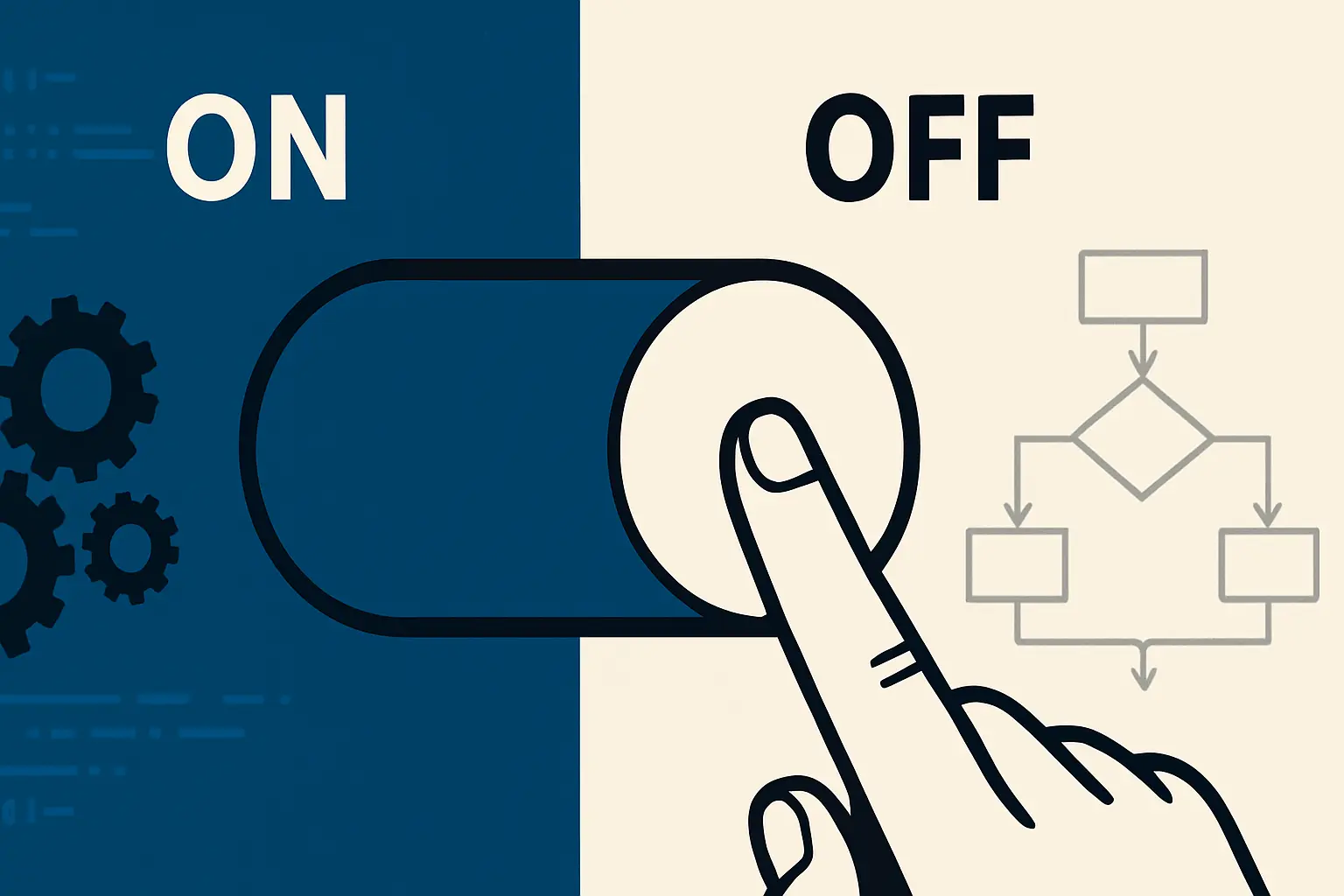
That incident solidified a principle I now apply to every system I build: automation must be reversible. You need a big, red, metaphorical button that allows a human to take control instantly, without shutting everything down.
The Hidden Risk of ‚All-In‘ Automation
We’re often sold on the idea of automation as a final destination—a self-sufficient system that removes human intervention entirely. But this ‚all-or-nothing‘ approach is fragile and a key reason so many digital transformation projects fail to deliver on their promise.
McKinsey & Co. research shows that up to 80% of digital transformations don’t achieve their intended results, and a staggering 70% of change management initiatives fail outright. I don’t believe this is because the technology is bad, but because we implement systems that are too rigid. We build one-way streets, forgetting that business is full of detours, exceptions, and smudged barcodes.
Irreversible automation creates a brittle system. When it works, it’s brilliant. When it breaks—or even just hesitates—it creates more work than it saves. Reversible Automation is the design philosophy built to counter this. It’s about building systems that are both intelligent and resilient.
What is Reversible Automation? A Simple Framework
At its core, Reversible Automation means designing every automated workflow with a built-in, easily accessible manual override. It’s not just an emergency stop button; it’s a fully parallel ‚manual path‘ the team can switch to at a moment’s notice.
Think of it like a car’s cruise control. You use it on the open highway to reduce cognitive load, but your foot is always ready to take over. The system is an assistant, not a replacement for the driver, and you can disengage it with a simple tap of the brake.
In our workflows, this translates to a clear switch point where a process can diverge from the automated path to a manual one without breaking the entire chain.
The key components are:
- The Trigger: An event that starts the workflow (e.g., a new lead comes in).
- The Automated Path: A sequence of actions performed by the system (e.g., score lead, assign to rep, send email).
- The Manual Path: A clear, documented process for a human to complete the same task.
- The Switch: A simple, one-click mechanism that diverts the process from the automated path to the manual one.
This isn’t about a lack of faith in automation. It’s a pragmatic acceptance of reality.
Why This Principle Matters: Lessons from the Field
Implementing this principle has fundamentally changed how we approach building new systems, whether at JvG Technology or in my marketing projects. It addresses three critical, often-ignored challenges.
De-Risking New Implementations
Building a manual override first allows us to adopt an agile-like approach to operational changes. We can launch a new automated system knowing that if it fails, the ‚blast radius‘ is contained. We aren’t betting the farm on a version 1.0.
This dramatically lowers the stakes. We can test new ideas, gather real-world data, and iterate without the fear of causing a system-wide meltdown. It’s a core tenet of good business system design: build for failure, not just for success. The override is our safety net, enabling faster and bolder experimentation.
Overcoming Team Resistance and ‚Automation Anxiety‘
Introducing new automation can be unsettling for a team. According to PwC, 37% of workers worry about their jobs being automated. This ‚automation anxiety‘ is a massive barrier to adoption. If your team feels they are being replaced, they will—consciously or subconsciously—resist the new system.
A reversible design changes this dynamic entirely. When you show the team the ‚off‘ switch, you’re sending a clear message: ‚This tool is here to help you, but you are still in control.‘ It transforms automation from a threat into a powerful assistant. This sense of agency is crucial for buy-in and makes the team a partner in the process, not its victim.
Preventing ‚Shadow IT‘ and Maintaining Control
When official systems are too rigid, employees become incredibly creative. They find workarounds—unapproved spreadsheets, third-party apps, personal email accounts. This phenomenon, known as ‚Shadow IT,‘ is rampant. Research from Everest Group suggests that 40% of all tech spending in large enterprises now happens outside the official IT department.
Shadow IT is a symptom of inflexible systems. A manual override provides the sanctioned, official workaround. It gives your team an approved escape hatch for handling edge cases, preventing them from going rogue and introducing security risks or data silos. It keeps all operations, automated or manual, within the ecosystem you designed.
A Practical Example: Automating Lead Qualification
Let’s apply this to a common business process. At Mehrklicks, we run various lead generation campaigns where we often aim to automate the qualification and assignment of new leads.
The Irreversible Way: A system automatically scores leads based on company size, industry, and form submissions. It then assigns them directly to a sales rep’s CRM queue. If the scoring logic is flawed or a high-value but unconventional lead comes in, it might get miscategorized or lost. To fix it, an engineer has to go in and tweak the code.
The Reversible Way: We build the same scoring logic, but with a switch. The system scores the lead and suggests an assignment. However, any lead with an ambiguous score is flagged for human review. The marketing manager can see the queue and, with a single click, toggle the ‚auto-assign‘ feature off for that specific lead (or for all leads if a campaign is behaving unexpectedly). They can then manually assign it. This approach is central to our marketing automation experiments, as it lets us test new logic safely.
The outcome is the same—the lead gets assigned. But the reversible process is resilient, transparent, and keeps the human expert in the loop.
Frequently Asked Questions about Reversible Automation
Isn’t building a manual override more development work?
Yes, it requires more thought and effort upfront. But the cost of building a small off-ramp is minuscule compared to the cost of a multi-hour operational shutdown, a lost high-value client, or a failed digital transformation project. It’s an investment in resilience that pays for itself the first time you use it.
When is automation mature enough to not need a manual override?
Almost never. Even the most sophisticated AI and machine learning models encounter edge cases they weren’t trained on. The world is messier than any dataset. The manual override shouldn’t be seen as a temporary crutch for new systems, but as a permanent feature of a mature and reliable one.
Does this apply to all types of automation?
It’s most critical for complex workflows involving decision-making, customer interactions, or dependencies on external data (like the smudged barcode). For very simple, isolated tasks, such as automatically copying a file from one folder to another, it might be less essential, but the principle of designing for failure remains a good habit.
Building Your First Reversible System
This isn’t a complex technical challenge; it’s a shift in design philosophy. You can start applying it today by asking a few simple questions before you build anything new.
-
What’s the escape hatch? Before you map the automated workflow, map the manual one. What are the exact steps a person would take if the system was down?
-
Where are the decision points? Identify the moments in the process where ambiguity is most likely. These are the perfect places to install a ’switch.‘
-
Can we turn it off easily? Ensure the manual override is accessible to the system’s user, not just the developer. It should be a button in the interface, not a line of code.
Automation is a powerful lever for scaling a business. But the most durable systems aren’t just powerful; they’re pragmatic. By embracing the principle of reversibility, we build systems that don’t just work in theory—they work in the messy, unpredictable real world. It’s a core part of the work I document here on Patrick-Thoma.com, where the goal is always to build systems that scale gracefully.