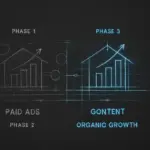
Our biggest marketing failure taught me a fundamental lesson about trust. For months, we treated visibility as the primary goal, running paid ad campaigns that brought traffic but little connection. The moment we turned off the budget, we became invisible again.
The realization was sharp and clear: we hadn’t built anything durable. Our most valuable asset—two decades of deep engineering knowledge from building solar factories at JvG Technology—was completely absent from our digital presence. It was trapped in schematics, technical manuals, and the minds of our engineers.
We had expertise, but we had no system for demonstrating it. That’s when we stopped chasing visibility and started building an asset: an Organic Trust Layer.
Observation: The Market Was Asking for a Blueprint, Not a Brochure
As I analyzed our incoming inquiries, a pattern emerged. Potential clients weren’t asking generic questions. They were asking highly specific, technical questions about things like EVA foil lamination tolerances or the throughput efficiency of stringer machines. They were deep in their decision-making process, and our marketing wasn’t meeting them there.
This observation is backed by broader data. Research shows that B2B decision-makers consume an average of 13 pieces of content before choosing a vendor, and a significant portion of that is educational. A study by the CMO Council revealed that the single most important characteristic for B2B content is the „depth of information and expertise“ it provides.
Our problem was clear: we were presenting a business card when our audience was looking for an engineering blueprint. They didn’t want to be sold to; they wanted to learn. They needed to trust our competence before they would even consider a commercial conversation. The lack of accessible, deep content wasn’t just a missed opportunity—it was a barrier to trust.
![A diagram showing a complex engineering schematic on one side, with arrows pointing to a clean, structured set of linked content modules on the other. The modules are labeled „Core Concept,“ „Process Breakdown,“ „Technical Specs,“ and „Common Faults.“]()
Framework: The Expertise Extraction and Translation System
We decided to treat our internal knowledge like a raw material that needed to be refined and structured before it had any market value. We designed a system to methodically convert raw technical expertise into a clear, accessible, and interconnected library of content.
This wasn’t about starting a blog; it was about architecting a knowledge base. Here’s how the system worked:
1. Deconstruction: Breaking Down the Machine
First, we conceptually disassembled a complete solar module production line, turning each machine, process, and critical component into a „content module.“ This approach shifted our focus from generic keywords like „solar manufacturing“ to technical realities like „Cell Stringing,“ „Electroluminescence Testing,“ and „Automated Bussing.“ This way, our content structure mapped directly to the physical structure of our engineering projects.
2. Translation: From Jargon to Clarity
The next step was translation. The goal was not to „dumb down“ the information but to distill it. I set a simple rule for our team: „Explain this as if you are onboarding a smart, capable engineer who is new to our specific technology.“ This simple prompt shifted the entire dynamic. It removed assumptions, forced the clarification of acronyms, and prioritized logical flow over academic language. It transformed dense internal documentation into valuable educational assets. We focused on explaining the why behind the engineering—a detail often missing from standard technical manuals.
3. Interlinking: Building a Knowledge Graph
Finally, we connected the modules. An article explaining the lamination process would naturally link to a deeper explanation of the EVA material itself, while a piece on cell testing would link back to the stringing process that preceded it. This created a self-reinforcing knowledge graph. A reader could enter at any point of interest and navigate logically through the entire system, going as deep as they needed. This mirrored how one might explore one of our automation and control systems, where every component is part of a larger, interconnected whole. This structure turned a collection of articles into a guided learning path.
Insight: Authority is Expertise Made Accessible
The core lesson from this project is that expertise itself is not a digital asset; it only becomes one when it’s systematized. True authority isn’t built by claiming you’re an expert; it’s built by creating a system that demonstrates expertise at scale, making complex knowledge accessible, navigable, and genuinely useful.
This shift in thinking—from creating content to engineering a knowledge system—was profound. We found that clarity became our most effective conversion tool. When a potential customer understands the complexities of what you do, trust is the natural outcome. They no longer see you as a vendor but as a capable partner. The Organic Trust Layer isn’t just about SEO; it’s about building an educational foundation so strong that your audience sees your solution as the only logical choice.
Frequently Asked Questions
How do you get busy technical experts to participate in content creation?
We don’t ask them to be writers. We treat them as subject matter experts in structured interviews. We record conversations where they explain a process as they would to a new colleague. The content team then translates that conversation into a structured, readable article. This respects their time and leverages their core strength: explaining what they know.
Isn’t this just a very detailed blog? What makes it a „system“?
A blog is often chronological or topic-based. Our approach is architectural. The content is structured to mirror a real-world system (the production line), with intentional links that create logical pathways for learning. This means the value of the whole is greater than the sum of its parts. It’s the difference between a pile of bricks and a well-designed building.
How do you measure the „trust“ this system builds?
We measure it through secondary metrics. Instead of just looking at traffic, we track engagement on these deep technical articles—things like time on page and pages visited per session. We also monitor the quality of leads, especially when an inquiry mentions a specific article. We know the system is working when we receive emails starting with, „I was reading your article on [highly specific technical topic], and it led me to a question about our project…“ That’s a direct signal of trust.
What is the next step after establishing this trust layer?
Once the foundation of trust and understanding is built, the next step is to explore how to guide that engaged audience toward specific solutions. This involves creating a Content Conversion Architecture that bridges the gap between education and action without resorting to aggressive sales tactics.