For years, our marketing systems operated with a clean division of labor. SEO built our library of long-term content assets designed to attract and educate, while Paid Media acquired users through targeted campaigns that drove immediate action. The two worlds ran in parallel, their performance reviewed in separate meetings and measured against separate goals.
The day we broke down that wall wasn’t a formal decision. It started with an observation—a pattern in the data that made little sense within a single channel but revealed a fundamental truth when viewed as a whole. It was the moment we stopped managing channels and started designing an intelligence system.
The Disconnected Signal: High-Engagement Ads, Stagnant Content
Our paid media team was excellent at running micro-experiments, particularly on Meta and Google Ads. Every week, they would test dozens of headline and description variations, hunting for the fractional CTR improvements that lower acquisition costs. One pattern began to emerge: certain ad variants would generate exceptionally high engagement—clicks, shares, comments—but deliver poor conversion rates.
Our old model would have dismissed these as failures. Since the ad didn’t produce a direct ROI, it was turned off. But the data point lingered: for a specific audience, a certain phrase or question was magnetic enough to stop them mid-scroll and compel them to click. The ad was a successful hook, even if the landing page was the wrong answer.
This matters because the buyer’s journey is no longer linear. Research shows that 93% of B2B buying processes begin with an online search, and 71% of those buyers consume blog content along the way. Our most valuable organic articles were our digital storefronts, yet we wrote them based on keyword research and intuition. Meanwhile, our ad campaigns were stress-testing thousands of messages against the live market every day. We were sitting on a goldmine of psychographic data and treating it like an expense line.
Building a Feedback Architecture
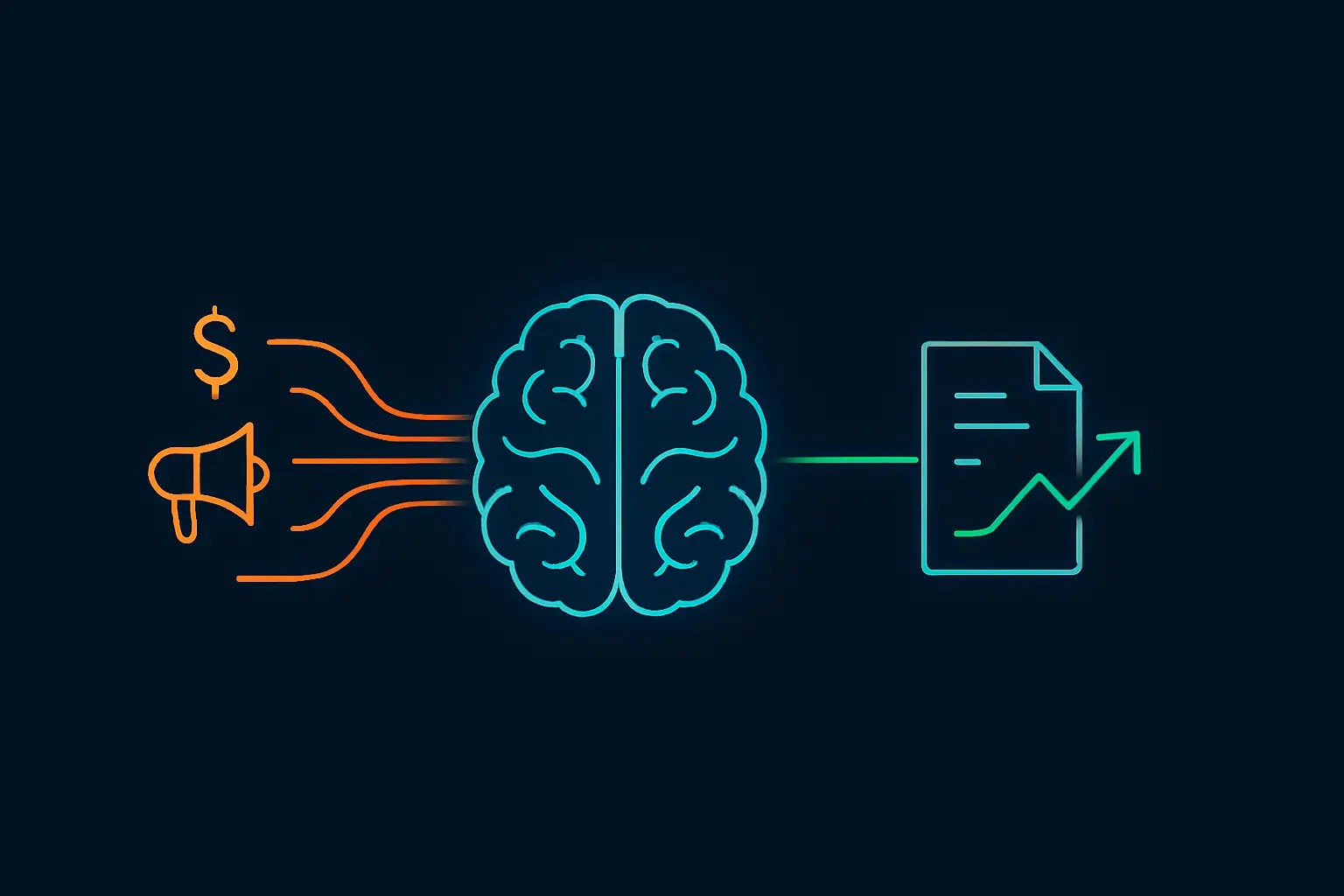
This observation led to a question: What if we used the language from our best-engaging ads to refine the messaging of our best-ranking content? We decided to build a simple, structured feedback loop connecting the rapid learning of paid media with the long-term authority of our organic content.
This wasn’t about rewriting articles from scratch. It was about surgically upgrading key elements—the title, the meta description, the opening paragraph—to reflect language already proven to capture attention.
Our framework was straightforward:
-
Isolate „Curiosity Signals“: We created a process to automatically tag ad variants that had high CTRs but below-average conversion rates. These were our signals—phrases that resonated with a user’s problem but failed to connect with our proposed solution.
-
Map Signals to Organic Assets: We linked each high-performing ad to the corresponding blog post that covered the same topic. For example, an ad about „solar panel degradation“ pointed to our long-form article on that subject.
-
Execute the „Content Upgrade“: We took the exact phrasing from the winning ad copy and used it to rewrite the H1 and meta description of the target blog post. The goal was to create a perfect message-match from the search engine results page (SERP) to the content itself. This small change transformed our content from being merely keyword-relevant to being psychologically resonant. Building this required thinking about our entire The Content System not as a collection of articles, but as a dynamic library that could be updated by external data.
-
Measure the Organic Uplift: We monitored Google Search Console and our analytics to track changes in organic CTR, time on page, and keyword rankings for the upgraded articles.
The process looked something like this:
The results were immediate. An article that had been ranking steadily at position four for a high-value keyword jumped to position two within weeks, and its organic CTR nearly doubled. Why? Because we finally aligned the language of the user’s question (which we discovered through ads) with the language of our answer (our blog post). This is a core function of a well-designed Digital Growth Engine; it creates feedback loops that make the entire system smarter.
The System Insight: From Spending to Learning
This experiment fundamentally changed how we viewed paid media. It was no longer just a tool for acquisition; it became our primary R&D lab for messaging. The money we spent wasn’t just buying clicks—it was buying data on what our market truly cared about, in their own words.
The real insight is that a marketing system’s intelligence is defined by the quality of its feedback loops. When channels are isolated, they can only learn within their own narrow context. When they’re connected, the learning from one becomes leverage for all the others. The speed of paid media can inform the authority of SEO. The engagement on social can refine the copy on a landing page.
By building this architecture, we weren’t just making our content better. We were embedding a learning mechanism into The Operating System of our growth model. The system itself started to learn faster than any single team could, turning disconnected campaigns into a coherent, self-improving ecosystem.
Frequently Asked Questions (FAQ)
What is a knowledge integration layer?
A knowledge integration layer is a system that uses data and insights from one marketing channel (like paid ads) to inform and improve the strategy of another (like SEO or social media). Instead of operating in silos, the channels „talk“ to each other, creating a self-learning system that optimizes the entire customer journey, not just individual campaigns.
Isn’t it risky to change successful blog content based on ad data?
It’s a calculated risk that can be managed with proper testing. We don’t recommend wholesale rewrites. The process described here is about making precise, surgical changes to high-impact elements like titles, meta descriptions, and introductions. By testing these changes and monitoring performance in tools like Google Search Console, you can quickly validate if the new messaging is improving organic performance—and revert if it isn’t.
How do you measure the success of this integration?
Success is measured by the performance uplift in the channel that receives the insight. In our example, the key metrics were:
- Organic Click-Through Rate (CTR): Did more people click on our article from the search results?
- Average Keyword Ranking: Did the article rank higher for its target terms?
- Time on Page / Engagement Rate: Once on the page, did users stay longer, indicating the content met the expectation set by the title?
Does this integration concept only work for B2B companies?
No, this principle is universal. Any organization using both content marketing (blogs, videos, articles) and paid advertising can benefit. A B2C e-commerce brand could use high-engagement ad copy from Instagram to refine product descriptions or email subject lines. The core idea is to use fast, paid feedback to improve slower, long-term assets, regardless of the industry.