I was halfway through a run, listening to a podcast on logistics systems, when a simple thought struck me. It was a potential solution to a minor but persistent bottleneck we’d been facing in our production line planning at JvG Technology. It was a good idea—maybe even a great one. But I was miles from my office, with no way to write it down.
For a moment, I felt that familiar, low-grade panic: the mental habit of repeating the insight in my head, hoping it would stick until I could get back to a keyboard. I’m sure you know the feeling. It’s the same anxiety that hits after a great meeting or a compelling article—that frantic internal effort to hold onto a fleeting insight.
This used to be a constant problem for me. Today, it isn’t. I finished my run, and by the time I was back at my desk, that idea was already waiting for me in my trusted system, ready to be directed to the right project. The mental energy I once spent just holding ideas is now free to actually develop them.
The High Cost of a Leaky Idea Funnel
We live in a flood of information. As founders and operators, we’re paid to find the signal in the noise. But what happens to that signal once we find it? Most of the time, it evaporates.
This isn’t a personal failing; it’s a biological one. In the 19th century, psychologist Hermann Ebbinghaus discovered the „Forgetting Curve,“ which shows that we lose about 50% of new information within an hour. Within 24 hours, that number jumps to 70%. That brilliant insight you have on your commute is, statistically speaking, doomed.
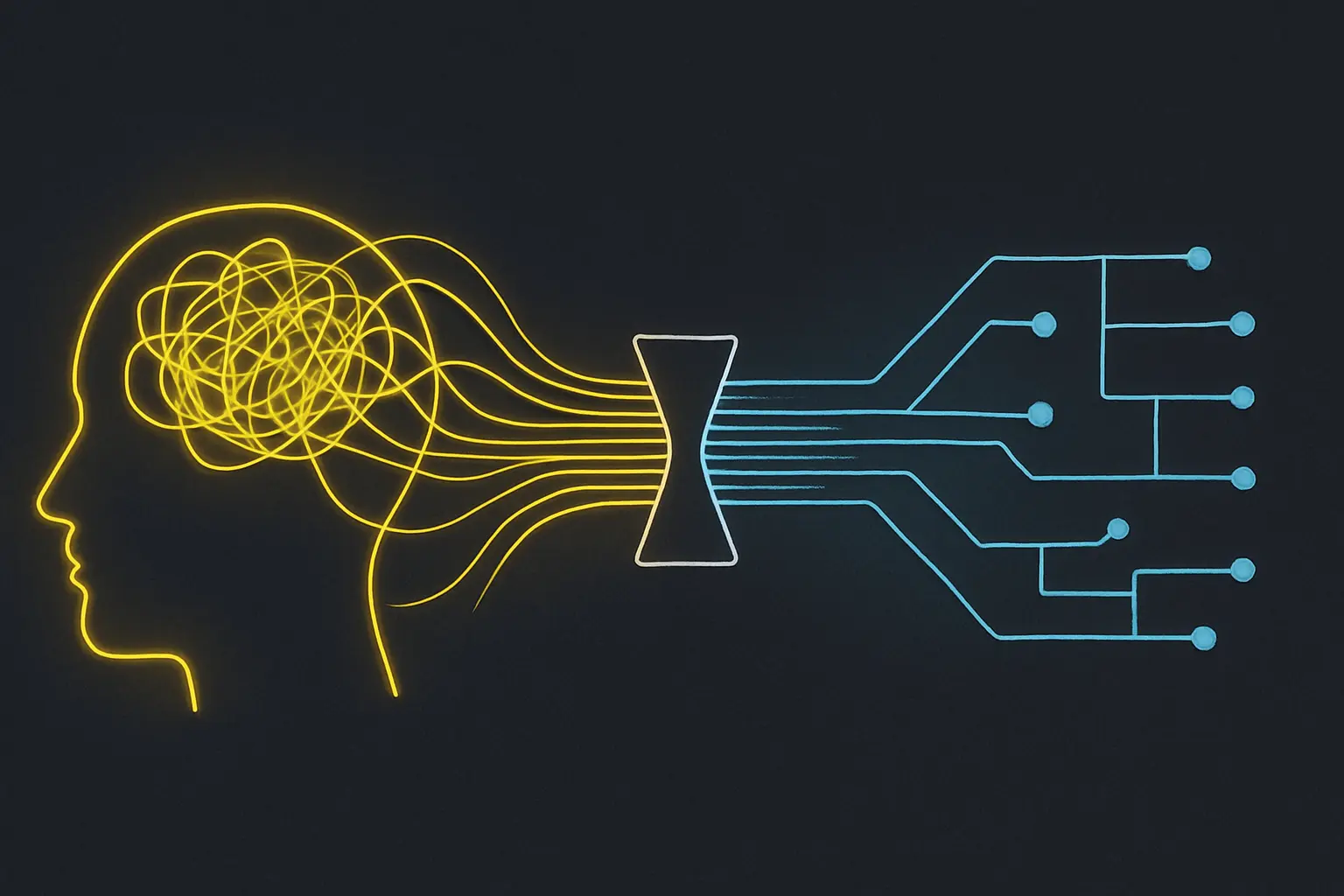
But the cost isn’t just the lost idea itself. It’s the mental tax we pay trying to prevent that loss. Psychologists call this the Zeigarnik Effect—our brains are wired to obsess over incomplete tasks or unhandled thoughts. When you try to hold onto an idea, your mind treats it as an open loop, constantly pulling at your attention. According to Cognitive Load Theory, our working memory is incredibly limited. Using it as a storage device for stray ideas, project reminders, and random insights clogs the very system we need for deep, strategic work.
An unprocessed idea is a mental weight. A dozen unprocessed ideas create a constant, distracting hum that undermines our ability to focus. Freeing up that mental bandwidth isn’t about having fewer ideas; it’s about building a trusted external system to handle them.
My Four-Step, Tool-Agnostic Capture Workflow
Over the years, across my different projects—from industrial engineering at JvG Technology to digital systems at Mehrklicks—I’ve honed a process to solve this. It’s not about a specific app, but a workflow grounded in a few core principles. It must be:
- Frictionless: Capturing an idea should take seconds.
- Universal: It must work for any type of information, from any source.
- Trusted: I have to be 100% confident that what goes in will be processed later.
This mirrors the core philosophy of David Allen’s “Getting Things Done” (GTD): get everything out of your head and into a trusted system. Here’s how it works.
Step 1: The Universal Inbox (Capture)
The goal is speed. The moment an idea surfaces, it needs a place to go immediately. I don’t analyze it, categorize it, or pretty it up. I just dump it. My universal inbox is a single, designated location. Sometimes it’s a specific app on my phone; other times it’s a voice memo. For you, it could be a pocket notebook. The tool doesn’t matter. What matters is that you have one place and can get the idea there in under 30 seconds.
Step 2: The Triage (Process)
This inbox is a temporary holding pen, not a permanent home. Once a day, usually first thing in the morning, I process everything in it. For each item, I ask a simple question: „What is this, and what needs to happen with it?“ The answer sorts it into one of three buckets:
- Trash: Irrelevant, duplicated, or no longer interesting. Delete without mercy.
- Actionable: An idea that requires a next step.
- Reference: A piece of knowledge, a quote, or an insight I want to save for later.
Step 3: The Routing (Organize)
This is where the idea finds its proper home.
- Actionable items are moved into the relevant project’s task manager or backlog. A thought about a new marketing campaign goes into the Mehrklicks backlog. A machine optimization note goes to the JvG engineering task list.
- Reference material is sent to my central knowledge base. This is the foundation of my long-term thinking and is central to my approach to building a second brain. It’s where I store insights, articles, and frameworks that aren’t tied to an immediate task.
Step 4: The Connection (Synthesize)
The final step is the most valuable. This system isn’t just a to-do list generator; it’s an engine for innovation. Author Steven Johnson calls this process the „slow hunch.“ He argues that world-changing ideas rarely arrive in a single flash of brilliance. Instead, they start as small, incomplete fragments that linger for years. They become powerful only when they collide with other fragments.
My reference archive—my second brain—is designed to facilitate these collisions. By capturing and tagging ideas, I create a searchable, interconnected web of my own thinking. This is where the principles of system design prove so critical; you’re designing an environment where serendipity is more likely to occur.
From Abstract Idea to Real-World Experiment
This process prevents good ideas from being lost, but more importantly, it turns them into tangible outcomes. A while back, I captured a thought while reading an article: „Could we use the same lead-scoring logic from our marketing CRM to prioritize supplier follow-ups at JvG?“
- Capture: The note went straight into my universal inbox.
- Triage: During my morning review, I marked it „Actionable.“ It was more than a thought; it was a testable hypothesis.
- Route: I moved it into our „JvG Labs“ project backlog with a note to discuss with the operations team.
- Action: That simple note became a small-scale experiment that ultimately refined our procurement process.
This is the same engine that fuels how we use automation in our marketing experiments. An observation becomes a note, a note becomes a task, and a task becomes a system improvement.
Building Your Own Knowledge Garden
The most powerful part of this system isn’t the tasks it generates but the knowledge it cultivates. Every non-actionable idea—every quote, statistic, or mental model—becomes a node in a growing network.
Over time, this becomes a private search engine for your own best thinking. When I start a new project, my first step is to search my own knowledge base. More often than not, the seeds of the solution are already there, waiting to be connected.
Frequently Asked Questions (FAQ)
What’s the best tool for this?
The one you’ll consistently use. The system is more important than the software. Start simple: a notes app for capture and a basic to-do list for actions. The key is to make the capture step as frictionless as possible.
How often should I process my inbox?
Daily is the ideal rhythm. It takes about 10-15 minutes and ensures the inbox never becomes overwhelming. If your idea volume is lower, weekly can work, but consistency is what builds the trust that allows your brain to let go.
What if an idea seems silly or small?
Capture it. The cost of capturing a useless idea is seconds. The cost of losing a brilliant one is immeasurable. Small, „silly“ ideas are often the fragments that connect to form a big one later on.
How do I avoid creating a digital junkyard?
The Triage step is your quality filter. Be disciplined about processing your inbox to zero regularly. If an item isn’t actionable or genuinely valuable as a long-term reference, delete it. A good system requires maintenance.
Closing Thoughts: Your Mind Is for Having Ideas, Not Holding Them
David Allen’s famous quote perfectly captures the goal of this workflow. Our brains are optimized for creative, connective thinking—not for acting as a biological hard drive.
By externalizing the task of remembering, we create the mental space needed for true clarity. This system isn’t about becoming a productivity machine; it’s about creating a calm, controlled cognitive environment where your best strategic thinking can emerge. It’s how you ensure that when insight strikes, it becomes the start of a process, not a source of anxiety.
If the thinking behind this workflow resonated with you, a good next step is to explore the principles of system design that inform how I build processes like this one across all my projects.