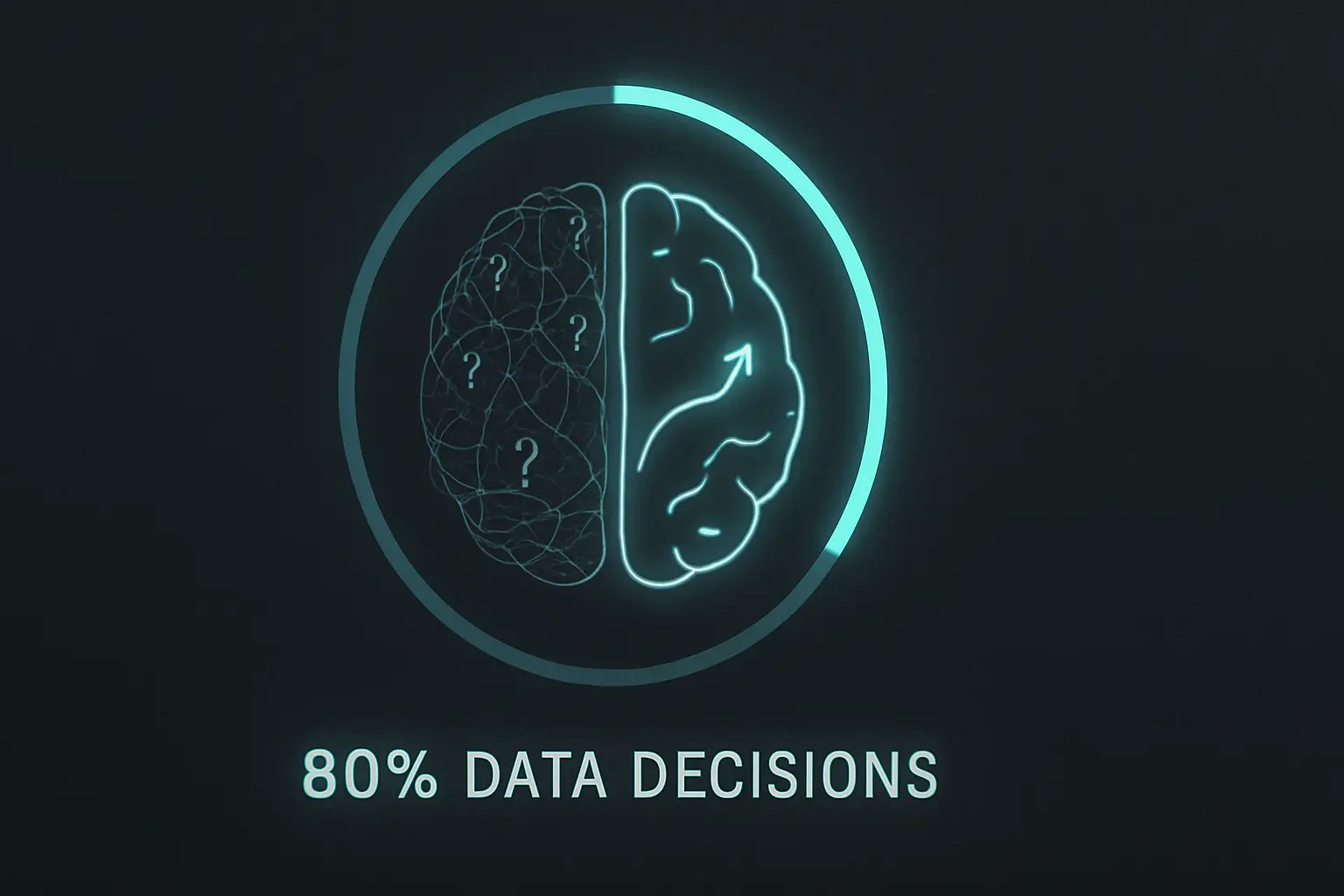
My Framework for ‚80% Data‘ Decisions: A Guide to Avoiding Analysis Paralysis
This week, I found myself in a familiar situation at JvG Technology. We were evaluating a potential new supplier for a critical component in our solar module production lines. We had quotes, spec sheets, and initial performance data—about 80% of what we’d ideally want to know. The final 20%, proving long-term reliability under extreme conditions, would only come with time—a luxury we didn’t have.
We could wait another six months for more comprehensive data, but that delay would postpone a major client project. Or we could make a call now with the information at hand.
This is a classic founder’s dilemma: the tension between the need for speed and the desire for certainty. Waiting for 100% of the information feels safe, but in business, standing still is often the riskiest move you can make. This is what led me to formalize the mental model I use for these moments: the „80% Data“ framework. It’s a system designed to overcome analysis paralysis when information is, as it almost always is, incomplete.
The Founder’s Dilemma: The High Cost of Waiting for Perfect Information
Analysis paralysis is the state of overthinking a decision to the point that a choice is never made, effectively paralyzing the outcome. As founders and operators, we’re conditioned to mitigate risk, and our first instinct is to gather more information—but that instinct has a point of diminishing returns.
The pursuit of absolute certainty is a trap. Studies from the University of Michigan have shown that in dynamic environments—like running a startup or scaling a company—excessive deliberation can lead to lower-quality decisions. The time spent chasing that last sliver of information is time your competitors are using to act. The opportunity cost of delay can be far greater than the risk of making a decision with good, but imperfect, data.
This isn’t about being reckless. It’s about being realistic. Business doesn’t happen in a laboratory; it happens in a complex, fast-moving system where you never have all the variables.
Introducing the ‚80% Data‘ Rule
The ‚80% Data‘ rule is my guideline for making a decision when I have roughly 80% of the information I wish I had. It’s an acknowledgment that the final 20% of data is often the most difficult, expensive, and time-consuming to acquire. More importantly, that final 20% is often not decisive enough to outweigh the cost of waiting.
It’s a practical application of the Pareto Principle, where the first 80% of your insight comes from 20% of the effort, while the final, elusive 20% takes the other 80%. My framework is designed to consciously accept this trade-off and move forward with clarity.
Whenever my team or I are spinning our wheels on a decision, I use a simple checklist to put this principle into practice. It’s my system for converting uncertainty into a structured action plan.
My Four-Step Checklist for an 80% Data Decision
This isn’t just a vague feeling; it’s a process. When a high-stakes decision is on the table and we’re stuck, I walk my team through these four questions.
1. Define the ‚Reversible Decision‘ Threshold
I borrowed this concept from Jeff Bezos’s framework of „one-way vs. two-way doors.“
-
A two-way door is a reversible decision. If you make the wrong choice, you can walk back through the door, learn from the experience, and try another path. Most decisions—hiring a new marketing agency, trying a new software tool, launching a new ad campaign—are two-way doors. For these, the 80% data rule is more than enough.
-
A one-way door is a decision with significant, irreversible consequences. For JvG, this would be something like building a new factory. You can’t easily undo that.
For a one-way door, the rigor is higher. We might push for 90% or even 95% of the data. But the principle remains: we will never have 100%. Classifying the decision’s reversibility sets the bar for how much data we really need.
2. Identify the ‚Most Valuable‘ Missing Information
When you’re facing a 20% information gap, it’s easy to feel overwhelmed by the „unknown unknowns.“ The key is not to find all the missing information, but to identify the single most critical piece.
I ask my team this question: „What one piece of information, if we had it, would most likely change our decision?“
This reframes the problem from a vague search for „more data“ into a targeted mission. Often, we find that the most valuable missing piece is either unattainable (e.g., „how will the market react in 12 months?“) or its answer wouldn’t actually change our path. This step cuts through the noise and often reveals that we already have what we need to proceed.
3. Stress-Test the Downside
Our brains are wired to fear loss more than we value gain. This concept of loss aversion is well-documented in behavioral economics, particularly in the work of Daniel Kahneman. My framework confronts this bias head-on by shifting the focus from the potential upside to the survivability of the downside.
Instead of asking „What’s the best thing that can happen?“ I ask: „If we make this decision and it’s wrong, what is the realistic worst-case scenario? Can we survive it? How quickly could we pivot?“
For the supplier decision at JvG, the worst-case scenario was that the components underperformed and we had to replace them, causing project delays and financial loss. We quantified that potential loss and built a contingency plan. Knowing we could absorb the worst-case outcome gave us the psychological safety to move forward without perfect information. It’s not about being an optimist; it’s about being a prepared realist.
4. Commit and Create an Iteration Loop
A decision made with 80% data is not the final word; it’s the start of a test. Once the decision is made, we commit fully, with no second-guessing. But we immediately set up a system to monitor the results and create a feedback loop.
This turns the decision into an experiment. The real-world results we gather post-decision are the missing 20% of the data we were looking for. This mindset is fundamental to how I run business experiments, and it transforms a decision into a learning opportunity. You form a hypothesis with 80% of the information, run the test by making the decision, and use the results to iterate. The choice isn’t the end of the process; it’s the beginning of discovery.
Frequently Asked Questions (FAQ)
What if the decision is highly critical, like a major capital expenditure?
The framework still applies, but the dials are turned up. For a „one-way door“ decision, the „Stress-Test the Downside“ step becomes a far more rigorous financial modeling and risk analysis exercise. We might push our data threshold to 90%. But the core purpose remains the same: to prevent the impossible search for 100% certainty from blocking necessary progress.
How do you know when you’ve reached 80% of the data?
It’s less a precise metric and more of an intuitive milestone backed by process. You reach 80% when you notice the rate of new, valuable information starts to slow dramatically. You’re spending significant time and resources to gain very small, incremental insights. That feeling of diminishing returns is your signal that you’ve likely gathered enough data to make a call.
Isn’t this just encouraging reckless decision-making?
Quite the opposite. It’s a highly structured system for mitigating risk in an uncertain world. True recklessness is being paralyzed by a lack of perfect information while your environment changes around you. This framework provides a disciplined way to act. It’s about being calculated, not careless. You can think of it as a documented procedure for navigating ambiguity.
Your Next Step: From Paralysis to Action
The goal of effective leadership and system design isn’t to eliminate uncertainty—that’s impossible. It’s to build robust processes that allow you to move forward with confidence in the face of it. The 80% Data framework is a tool for building that momentum.
The next time you feel stuck, try running your decision through this four-step checklist. Start with a small, reversible „two-way door“ decision this week and see how it reframes your perspective.
Ultimately, this is about more than just a single decision; it’s about building resilient systems for growth. The best systems don’t just work when everything is perfect—they excel when things are uncertain.