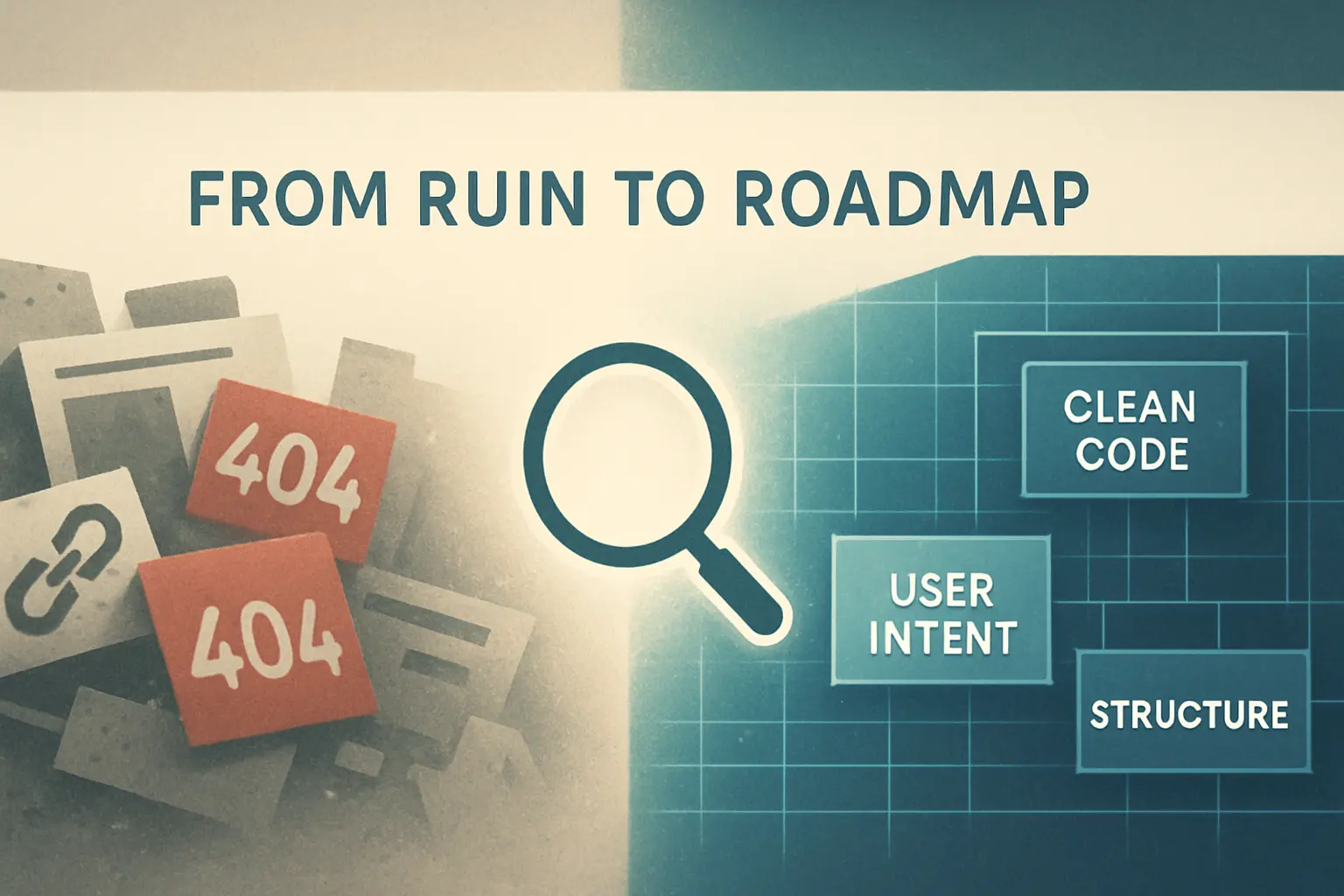
The first crawl report for Photovoltaik.info was like an archaeological dig. After five years of dormancy, I expected to find a quiet, empty landscape. Instead, we uncovered a digital ruin—a sprawling site map haunted by the ghosts of pages long past. Google’s memory proved far longer and more detailed than we had anticipated. Our first diagnostic crawl revealed that of the roughly 11,000 URLs Google still associated with the domain, a staggering 22% returned a „404 Not Found“ error.
This wasn’t a clean slate. It was a foundation cluttered with debris.
Observation: Mapping the Ruins
Our initial task wasn’t to build, but to map what remained. We categorized the domain’s digital footprint into three distinct groups:
-
The Dead (2,400+ URLs): These were the hard 404s. Pages that once existed—press releases from 2012, product spec sheets for discontinued modules, old event announcements—were now gone. Each one was a broken promise to both users and search crawlers, creating a landscape of dead ends that eroded trust.
-
The Ghosts (6,300+ URLs): This was the most problematic category. These pages resolved with a „200 OK“ status, technically „live,“ but contained little to no value. They were thin, auto-generated directory listings, outdated manufacturer profiles with broken links, and thousands of tag pages creating a spiderweb of duplicate or near-duplicate content. These ghosts in the machine consumed crawl budget and signaled to search engines that the site was a low-quality archive, not a living resource.
-
The Survivors (approx. 2,300 URLs): Buried within the noise were a few hundred pages that, despite their age, still held some relevance. Here we found foundational articles explaining core concepts like „grid parity“ or „monocrystalline vs. polycrystalline.“ Though outdated and poorly structured, they represented the domain’s original purpose: to educate. It was a faint pulse, but it was there.
This diagnostic phase was critical, showing that the primary challenge wasn’t a lack of content, but a lack of structure and an excess of noise. The domain’s authority was being actively diluted by its own history.
Framework: From Diagnosis to a Cleanup Protocol
Armed with this data, we established a simple, methodical framework for the cleanup. It wasn’t about subjective opinions on what „looked good“; it was a logical process for restoring technical integrity.
Our protocol was straightforward:
- Acknowledge the Dead: We didn’t ignore the 404s. We logged them to understand what users or other sites might have been linking to, creating a „redirect map“ for later.
- Exorcise the Ghosts: Every thin or duplicate page was flagged for removal. The goal was to drastically shrink the domain’s surface area, forcing search engines to re-evaluate the site based on a smaller, higher-quality core.
- Isolate the Survivors: The pages with potential were cordoned off into a separate „review“ silo. These would not be part of the new site launch initially but would serve as the raw material for future, updated content.
This wasn’t an SEO strategy in the traditional sense. It was about basic system hygiene. By methodically clearing away the debris, we were preparing the ground for something new. We were making a clear statement: the era of neglect is over. The work wasn’t yet about adding anything new; it was about honoring the domain’s history by cleaning it up.
Insight: A Domain’s History is a Permanent Record
The key insight from this phase was humbling: you don’t get to choose what the internet remembers about your domain. A five-year silence doesn’t erase what came before. That history, with all its broken links and outdated information, remains part of your digital identity.
Reviving a domain isn’t about starting over. It’s about taking responsibility for its entire timeline. The first step in Building Systems that scale is to create a clean, predictable environment. In this case, that meant respecting the domain’s past by systematically tidying it up, creating a foundation of trust we could build on.
Project Log: When Deleting 80% of Your Content is the First Step to Growth
Our first major strategic decision for Photovoltaik.info was an act of removal. After diagnosing the domain’s condition, we flagged over 8,700 of the 11,000 indexed pages for deletion. To an outsider, intentionally shrinking a domain by 80% might seem like digital self-sabotage. For us, it was the only way to signal a profound shift in quality and intent.
Addition by subtraction is a powerful, yet often overlooked, principle in system design. Before we could build a trusted educational resource, we had to tear down the sprawling, neglected structure that stood in its place.
Observation: The Anatomy of Digital Decay
The content audit was less of a creative review and more of a forensic analysis. The 8,700 pages slated for removal fell into several categories of digital decay, each contributing to the domain’s stagnation:
- Obsolete News Archives (approx. 3,000 pages): Reports on trade shows from 2011 or policy changes from 2013. Though historically accurate, this content offered zero value to a user today and created keyword cannibalization, competing with any new, relevant content we might produce.
- Thin Manufacturer Profiles (approx. 2,500 pages): Thousands of auto-generated pages, one for each solar module manufacturer, often contained just a logo and a broken link to their website. Offering no unique insight, they were the very definition of „thin content“ that search engines devalue.
- Endless Tag Pages (approx. 3,200 pages): The old system had generated a tag for nearly every conceivable keyword, creating thousands of pages that simply listed links to other articles. This practice led to a massive amount of internal duplication and a confusing user experience.
These pages weren’t just inert; they were actively harming the domain’s reputation with search engines, signaling that quantity had been prioritized over quality for years.
Framework: A Ruthless Logic for Content Pruning
To make this process objective, we developed a simple decision-making framework for every single URL, asking a cascade of three questions:
- Does it have enduring value? Is the information on this page still relevant and useful today? A page explaining how a solar cell works has enduring value. A page announcing a product launch from 2014 does not.
- Can it be salvaged? If the core topic is valuable but the content is outdated, can it realistically be updated to meet our new quality standards? This separated the „survivors“ from the „ghosts.“ A foundational article on solar incentives could be updated; a list of defunct manufacturers could not.
- Does it serve a clear user intent? Every page that remains must have a purpose. It must answer a specific question or guide a user through a specific task. The tag pages and empty profiles served no clear intent and were the first to go.
Anything that failed this test was mapped for a „410 Gone“ status—a technical signal that tells search engines the page has been intentionally and permanently removed. This signal is stronger than a 404 and accelerates the de-indexing process. This systematic pruning was the core of our strategy for Running Experiments with the domain’s structure.
Insight: Clarity is a Function of Elimination
The key takeaway from this massive content cleanup was this: You cannot establish authority until you first establish clarity. A domain cluttered with thousands of low-value pages sends a mixed, unfocused signal. It tries to be everything to everyone and ends up being nothing to anyone.
By deleting 80% of the content, we weren’t losing value; we were eliminating noise. This act of strategic removal focused the domain’s identity, allowing the few hundred pages of genuinely useful, albeit outdated, content to stand out. It was the necessary first step in transforming the domain from a forgotten archive into a curated, trustworthy library. Growth, in this early stage, wasn’t about what we added, but about the focus we created through what we took away.
Project Log: Rebuilding a Site’s Navigation Around Intent, Not Topics
The old site map for Photovoltaik.info was a reflection of the industry’s product catalog: Modules, Inverters, Storage, Mounting Systems. It was logical from a manufacturer’s perspective. But users don’t arrive looking for a product list; they arrive with a problem to solve or a question to answer. „Is my roof suitable for solar?“ „How much can I save on my electricity bill?“ „What happens on a cloudy day?“
Our first architectural task was to rebuild the site’s foundation around their questions, not our topics. This meant shifting from a topic-based hierarchy to an intent-based one.
Observation: A Disconnect Between Structure and Need
An analysis of the „survivor“ pages and historical search data revealed a clear disconnect. The old structure forced users to know industry jargon before they could find what they were looking for. To learn about system costs, you had to navigate through three different product categories and piece the information together yourself.
This approach created a high cognitive load, making the user do the work of a consultant. A modern educational platform must do the opposite: anticipate the user’s journey and guide them through it.
We mapped the core user intents we wanted to serve:
- Exploration: Users at the very beginning, asking „what if“ questions.
- Planning & Evaluation: Users who are seriously considering solar and need practical, financial, and technical details.
- Optimization & Operation: Existing solar owners looking to maximize their system’s performance or troubleshoot issues.
The old architecture served none of these journeys coherently.
Framework: From Silos to Guided Journeys
Our new information architecture was designed around content hubs, or „cornerstone“ guides, that directly addressed these core intents. Instead of a navigation link for „Inverters,“ we designed a comprehensive journey called „How to Plan Your Home Solar System.“
This central guide then links out to more specific, detailed articles (spokes) that answer sub-questions:
- How to assess your roof’s potential.
- Understanding different types of solar panels.
- Choosing the right inverter for your needs.
- A guide to battery storage options.
This „hub-and-spoke“ model supports our Building Systems approach in several critical ways:
- It aligns with the user’s mental model, starting broad and allowing them to drill down into specifics as they become more educated and confident.
- It creates a clear hierarchy for search engines. The „hub“ page consolidates authority on a broad topic, while the „spoke“ pages target more specific long-tail keywords, making the structure highly efficient for SEO.
- The model is also scalable. As we create more content, we can easily add new „spokes“ to existing hubs or build new hubs to address emerging user intents, all without needing to redesign the entire navigation.
Every piece of content now has a logical home within a user’s journey. The architecture itself becomes a teaching tool.
Insight: Good Architecture is an Act of Empathy
The most profound realization during this phase was that a clear information architecture is not just a technical or SEO exercise, but an act of empathy for the user. It demonstrates that you understand their questions, respect their time, and are committed to guiding them toward a clear answer.
By shifting from a self-referential, topic-based structure to an external, intent-based one, we changed the fundamental posture of the domain. It stopped being a passive directory of information and started becoming an active guide. This structural clarity is the first and most powerful signal of trust you can send to a new visitor, long before they read a single word. It says, „You’re in the right place, and we know how to help you.“
Project Log: Clarity as the First Signal—Rebuilding Trust with Clean Code
Before our editorial team wrote a single new sentence for Photovoltaik.info, our technical team sent the first and most important signal to both users and Google: this domain is now under new, careful management. That signal wasn’t content; it was clean HTML, fast load times, and a stable, predictable structure.
In the process of reviving a dormant asset, technical recovery is not a final polish, but the foundation. You cannot build content authority on a crumbling technical base. Our first act of communication was to prove, through code, that we were serious about quality.
Observation: The Weight of Technical Debt
The few „survivor“ pages we kept from the old site were burdened with significant technical debt—the implied cost of rework caused by choosing easy, short-term solutions over more sustainable ones.
Here’s what we found:
- Bloated Code: Years of different plugins and legacy scripts had left behind messy, inefficient code that slowed down page rendering.
- Poor Mobile Experience: The old design was not responsive. On a mobile device, it was nearly unusable, a critical failure in today’s mobile-first world.
- No Structured Data: There was no schema markup to help search engines understand the content. An article wasn’t identified as an article, a guide wasn’t a guide. To a crawler, it was all just a generic block of text.
- Slow Load Times: The combination of large, unoptimized images and inefficient code resulted in Core Web Vitals scores deep in the „red.“ Pages took several seconds to become interactive, creating a frustrating user experience.
This technical state of disrepair sent a clear signal: neglect. It actively worked against any trust we hoped to build.
Framework: A Protocol for Technical Excellence
Our approach was to establish a new, non-negotiable technical standard for every single page published from this point forward. This wasn’t about chasing perfect scores; it was about implementing a robust and repeatable system. This is a core idea in all our Running Experiments: build the system first, then create the content.
Our protocol focused on three pillars:
- Speed by Design: We built the new site template from the ground up with performance in mind. This meant minimal JavaScript, next-gen image formats (like WebP), and efficient server-side caching. Our goal was a Largest Contentful Paint (LCP) of under 1.5 seconds for all new articles.
- Structure via Schema: We implemented comprehensive schema markup for all content types. Articles are identified as Article, FAQs are wrapped in FAQPage schema, and so on. This translates our human-readable content into a machine-readable format, one that search engines can easily understand and use for rich results.
- Accessibility as Standard: We built for accessibility from the start, ensuring proper color contrast, ARIA labels for interactive elements, and a logical tab order for keyboard navigation. A site that is accessible to everyone is also, by definition, more clearly structured for search engine bots.
By committing to this protocol, every new piece of content we publish automatically inherits a strong technical foundation. It’s a system that prevents technical debt from accumulating again.
Insight: Technical Health is the Bedrock of Authority
The ultimate lesson from this technical cleanup is that you earn the right to be heard through operational excellence. In the digital world, clean code and fast performance are proxies for trustworthiness and professionalism.
Before a user reads your headline, they experience your load time. Before Google analyzes your keywords, it crawls your HTML structure. These technical „first impressions“ set the tone for everything that follows. By fixing the foundation first, we sent the clearest possible signal that Photovoltaik.info was no longer an abandoned archive but a professionally managed, high-quality resource. Technical health isn’t an „SEO tactic“; it’s the fundamental price of entry for building authority today.
Conclusion: From Recovery to Growth
With a clean, well-structured, and technically sound foundation in place, the project moves from recovery to growth. The focus can now shift entirely to creating high-quality, educational content that delivers on the promise of our new architecture and technical excellence. The system is built; now it’s time to populate it with value.
Frequently Asked Questions (FAQ)
What is a „404 error“?
A 404 error is a standard HTTP status code indicating that the server could not find the requested resource. For a user, it means clicking a link that leads to a „Page Not Found“ message. A high number of 404s can signal to search engines that a site is poorly maintained.
What does „crawl budget“ mean?
Search engines like Google allocate a finite amount of resources to crawl any given website. This is the „crawl budget.“ If a large portion of this budget is spent crawling thousands of low-value or non-existent pages, the search engine may not get to your most important content in a timely manner.
Why is duplicate content a problem?
Duplicate content confuses search engines. When the same or very similar content appears on multiple URLs, the search engine has to decide which one to show in search results. This can dilute the authority of the original page and lead to unpredictable rankings.
What’s the difference between a „404 Not Found“ and a „410 Gone“ status?
Both indicate a resource is not available. A 404 is a generic „not found“ message, implying the page might be temporarily unavailable or may return later. A 410 is a more definitive signal that the page has been permanently removed and will not be coming back. For SEO, a 410 can encourage Google to de-index the URL more quickly.
What is „keyword cannibalization“?
This occurs when multiple pages on your website compete for the same search keyword. For example, having ten old news articles about „solar panel prices“ could prevent a new, comprehensive guide on the same topic from ranking well, as the search engine doesn’t know which page is the most authoritative.
Is it always a good idea to delete old content?
Not necessarily. The decision should be data-driven. If an old page still receives traffic, has valuable external links pointing to it, or covers a niche topic well, it’s often better to update and improve it rather than delete it. Our mass deletion was an extreme case for a long-neglected domain.
What is „information architecture“ (IA)?
Information Architecture is the practice of organizing, structuring, and labeling content in an effective and sustainable way. The goal is to help users find information and complete tasks. For a website, this includes things like navigation menus, URL structures, and content categories.
What is a „hub-and-spoke“ content model?
This is an SEO and content strategy where a central „hub“ page is created on a broad topic (e.g., „Solar Panel Guide“). This hub page then links out to multiple, more in-depth „spoke“ pages on specific sub-topics (e.g., „Monocrystalline Panels,“ „Panel Efficiency Ratings,“ „Cleaning Your Panels“). This model helps establish topical authority.
What is user intent in the context of SEO?
User intent refers to the primary goal a user has when they type a query into a search engine. Common intents include informational (looking for an answer), navigational (looking for a specific site), commercial (investigating products or services), and transactional (ready to make a purchase). Aligning content with user intent is crucial for ranking well.
What are Core Web Vitals?
Core Web Vitals are a set of specific factors that Google considers important in a webpage’s overall user experience. They are made up of three specific page speed and user interaction measurements: Largest Contentful Paint (LCP), First Input Delay (FID), and Cumulative Layout Shift (CLS).
What is Schema Markup (Structured Data)?
Schema markup is a form of microdata that, once added to a webpage, creates an enhanced description (commonly known as a rich snippet) that appears in search results. It helps search engines understand the context of your content. For example, you can use it to tell Google that a piece of content is a recipe, an event, or an article.
What does „mobile-first indexing“ mean?
This means that Google predominantly uses the mobile version of the content for indexing and ranking. For years, the index was based on the desktop version. This shift means that having a high-performing, fully-featured mobile site is more important than ever.